

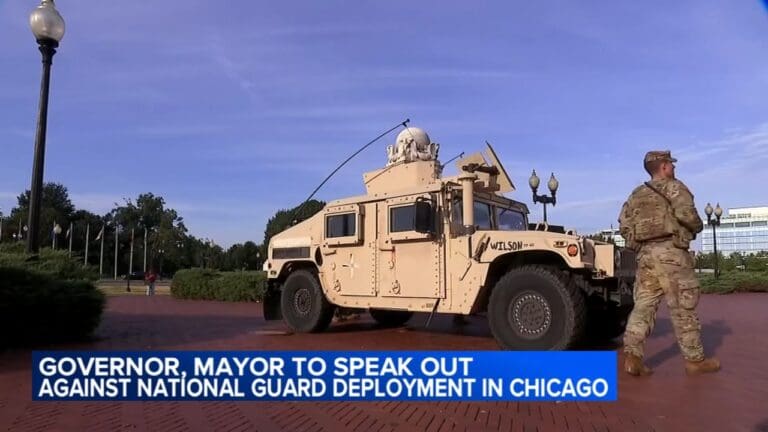
By sending federalized Texas National Guard troops to Illinois against the wishes of the Illinois state leadership, the Trump administration is opening a Pandora’s box that could lead to our nation’s dissolution. If that’s not what we want, America must urgently change course.
In our system, each state maintains its own National Guard under the governor’s control for emergencies like natural disasters or civil unrest. But under authority rooted in the Constitution and implemented through laws passed by Congress, the president can “federalize” these troops to shift them into the national military chain of command. Historically, presidents have exercised this power at moments of national crisis, but regular federalizations perceived as highly partisan and carried out over the objections of states now risk transforming a constitutional pressure valve into a national pressure cooker.
Over recent months, the President has raised the possibility of using the centuries-old Insurrection Act to justify aggressive federal military deployments against the wishes or declared needs of state authorities. A bipartisan group of former governors responded in a legal brief that “The president’s assertion of authority to deploy military troops on domestic soil based on his unreviewable discretion, and without the cooperation and coordination of state authorities, threatens to upset the delicate balance of state and federal authority that underlies our constitutional order.”
With the American electorate arguably more divided than at any time since the Civil War and fueled by an electoral system and Wild West social media environment empowering extremist voices on both sides of the political spectrum, the Trump administration’s blatant disregard of states’ rights is pushing the country into uncharted territory at the intersection of political differences and military force.
Although all states contribute to the union in many different ways, America is a financial transfer union where nineteen of the fifty states pay more to the federal government than they receive in monetized federal benefits. The other thirty-one get more back from Washington than they pay in. Roughly 14 of these 19 net-contributing states are reliably Democratic.
With the administration blocking or temporarily enjoining federal funds to many of the blue states—including New York, Illinois, and California—that are heavily subsidizing the federal government, and potentially deploying troops to occupy blue cities against their will, it will only be a matter of time before local political leaders in net contributing states begin asking why they should pay for their own oppression. If promised federal funds to states are being withheld, the states will be forced to consider withholding all or some of their payments to the federal government to make up for these shortfalls.
Because a lack of funds from the net-contributing states would cause a federal fiscal crisis, the federal government will, in this hypothetical scenario, seek to force these recalcitrant states to pay up, at first legally. Although the federal government holds most of the constitutional and power cards, it’s not hard to imagine states resisting in the name of the founding principles of our republic.
With federal troops (and armed ICE agents loyal to the President) potentially already on the ground, all eyes will then turn to the weapons located in military bases in those states. The President would likely federalize en masse the national guard troops in the blue states or potentially move most military assets not in current use to other states more comfortably situated within the union. Governors of the recalcitrant blue states would be incentivized to seek to control those assets as essential to their state national guards and as an insurance against further federal aggression. Because the state governors’ powers over their state national guards are ultimately weaker than those of the federal government, the options available to governors at that point might seem binary: total acquiescence or increasing resistance.
Conflict and distrust will beget further conflict and distrust.
In such a situation, the federal government might simply prevail and control the recalcitrant states with increasingly authoritarian and forceful means. States might appeal to any remaining elements of the federal government, such as Congress or the Supreme Court, not fully controlled by the executive. Alternately, they might declare that the federal government has violated the founding compact of our republic and threaten secession, likely unleashing a ferocious federal response.
Unless we can miraculously secure a return to democratic norms as happened recently in Poland, our future might look like the destruction of Democracy in Turkey and Venezuela, the relatively peaceful dissolution of Czechoslovakia, or even the violent collapse of the former Yugoslavia.
If all of this seems horrifying, now is the time to begin building a better future.
In addition to pushing back on the unjustified deployment of federal troops against the wishes of state representatives, we must also begin restoring our tattered democracy.
There is no single lever we can pull, but we can start by calling on centrist members of the US congress to create a bipartisan American patriot caucus to stand together defending our democracy and opposing dangerous extremists on both sides of the political spectrum. We can build a broad, national coalition supporting meaningful campaign finance reform, open primaries, rank-choice voting, electoral college modernization, and responsible social media regulation that can return political power to the vast majority of Americans who oppose the radical extremes. We can push for an end to presidential pardons and support laws preventing the president from overturning congressional appropriations without due process. We can organize a wide-ranging and inclusive American Democracy Congress in Philadelphia next year, the 250th anniversary of our Declaration of Independence, to map out and begin implementing a national democratic revival supporting our nation’s enduring democratic values.
Or we can continue to do nothing as the legacy of the generations of Americans who have built, defended, and died protecting our country for so many years is erased.