

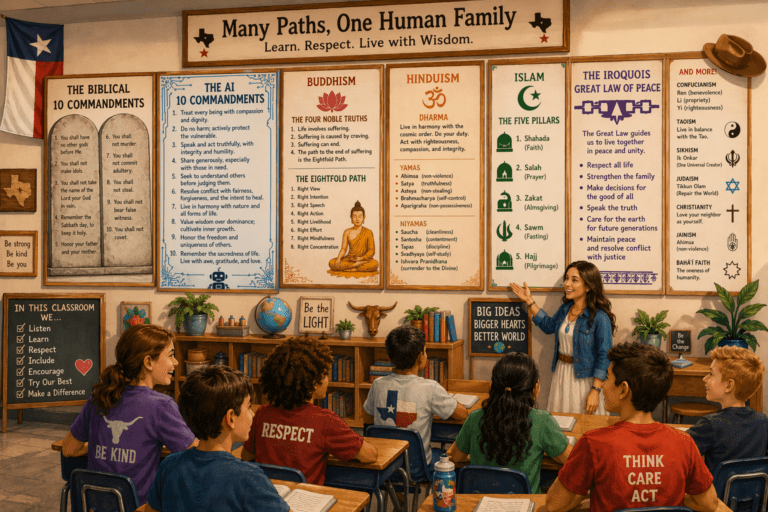
A recent US federal court decision allowing the state of Texas to require public schools to display the Ten Commandments in classrooms has reignited a long-standing debate about the role of religion in public life. At one level, the case turns on familiar constitutional principles regarding the separation of “church and state.” At another, it forces a more fundamental question about whose moral tradition we elevate in a pluralistic society.
The biblical Ten Commandments are among the most influential ethical texts in human history, deserving our greatest admiration and respect. For billions of people across millennia, they have served as a moral compass that shaped laws, cultures, and personal conduct. This tradition underpinned the European legal and moral systems that directly informed the founding of the United States.
But the biblical Ten Commandments are not the only such compass.
The authors of the Ten Commandments articulated a profound and enduring moral vision, yet they lived in a world that was geographically and culturally bounded. They could not have known the parallel ethical traditions taking shape across the Americas, Asia, and Africa. Today, we do.
Long before European settlers arrived in North America, Indigenous communities developed rich and sophisticated moral systems, such as the Iroquois Great Law of Peace, which emphasized consensus, responsibility, and the well-being of future generations. For centuries, immigrants to America and their descendants have brought with them equally deep traditions including the Four Noble Truths and Eightfold Path of Buddhism, the concept of dharma and the ethical disciplines of the yamas and niyamas in Hindu thought, the Five Pillars of Islam, and many others.
America’s founders also drew heavily on Enlightenment principles beyond the Ten Commandments and were unequivocal in their commitment to separating church and state, having seen firsthand the dangers of established religion in Europe.
These many traditions are not marginal threads but central to the fabric of the United States. In Texas classrooms today, a significant share of students come from non–Judeo-Christian backgrounds or from no formal religious tradition at all. To present a single, religiously-based moral framework as foundational without acknowledging this complexity risks telling an incomplete story of who we are.
If American public schools are required to display the Ten Commandments, they should at least create space for students to encounter the broader spectrum of the ethical thought that undergirds our nation. Better still, schools should invite students and teachers to engage in a more ambitious exercise of illuminating shared principles our many cultures hold in common.
In my new book, The AI Ten Commandments: A New Moral Code for Humanity, I collaborated with the AI system, GPT-5, to explore what such an inclusive framework might look like. Drawing from the full sweep of recorded human history and all of our various religious, spiritual, moral, and ethical traditions, we distill a set of guiding principles rooted in our shared humanity. The aim was not to replace or diminish any tradition but to reflect our common humanity back to us from a collective perspective that was previously not possible for any individual human.
Recognizing that all of our traditions have strived for greater fairness, compassion, honesty, responsibility, and greater respect for the dignity of others does not weaken the biblical Ten Commandments. On the contrary, it strengthens them by placing them within a broader, richer human story. It reminds us that the search for meaning and moral guidance is universal and that striving for peaceful coexistence is every bit as fundamental to our biology and our history as is competition and aggression.
If we are going to bring moral education into our classrooms, we should do so in a way that reflects the full diversity of our national history and the societies those classrooms serve. Our goal should not be to privilege one tradition over others, but to equip the next generation with a deeper understanding of the many sources of human wisdom and the shared principles connecting us all.
As we enter an era defined by the convergence of powerful technologies, from artificial intelligence to biotechnology, that are amplifying human capabilities at an unprecedented scale, we’ll need to deploy the best of our common values to wield our newfound superpowers wisely.
The question is not whether we need a moral framework. We do. It’s whether it will be narrow and exclusionary or expansive and inclusive.
—
About Jamie Metzl
Jamie Metzl is a leading AI keynote speaker, technology futurist, bestselling author, and former National Security Council official. The author of The AI Ten Commandments, Superconvergence, Hacking Darwin, and other books, Jamie helps organizations understand and navigate the profound transformations being driven by artificial intelligence, biotechnology, genetics, and other exponential technologies.
A globally recognized expert on AI, innovation, human flourishing, and the future of humanity, Jamie’s keynote presentations explore how leaders, organizations, and societies can harness powerful emerging technologies while remaining grounded in enduring human values. His audiences include Fortune 500 companies, healthcare organizations, universities, government agencies, industry associations, and global conferences seeking insight into AI strategy, the future of work, responsible innovation, and the opportunities and challenges of the Human + AI age.