

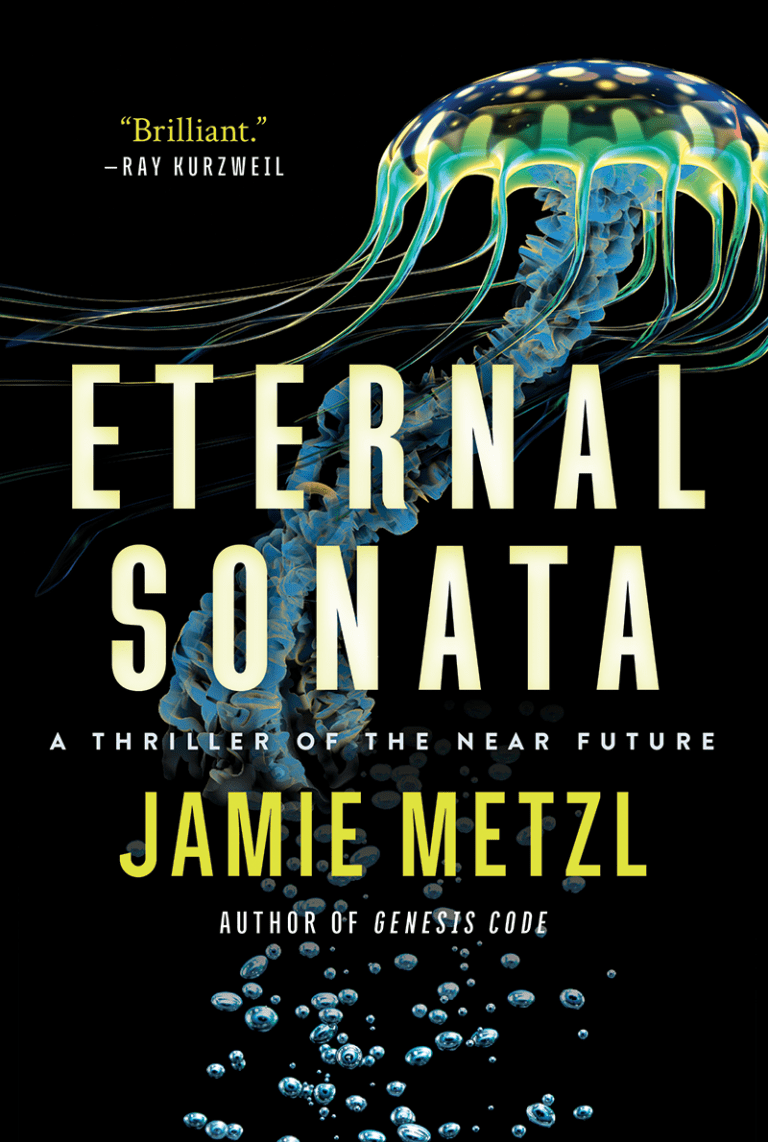
In my 2016 sci-fi thriller, Eternal Sonata, one of the main characters I imagined into being was a brilliant scientist, who was also a gifted musician who played Bach with his equally brilliant, beloved scientist wife. When his wife got cancer, he immediately shifted all of his energies to finding a cure. After he failed and she died, he did two things that laid the foundation for the book.
The first was to create a computer program to endlessly variate on the types of Bach sonatas he and his wife had played together. These “eternal sonatas” were not pure Bach but retained the essence of the essential Bach composition as they explored endless variations.
While these eternal sonatas played in the background at his increasingly isolated lab, he obsessively pursued his efforts to use epigenetic reprogramming to take cancer cells back in time to a pre-cancerous state. These efforts to revert the cancer cells worked with cells in a dish but didn’t work in complex animals because the other cells in those animal bodies kept rejecting the reverted cells. In trying to solve that problem, he eventually realized that the best path forward was to not just revert the cancer cells but to revert all of the cells. To his amazement, he discovered that reverting the cellular age of all the cells unlocked the key to reverting both the cancer cells and the aging process more generally. Recognizing the implications of and risks associated with this work, he hides his notes to make sure they cannot get into the wrong hands.
Because it’s a thriller and because those seeking to overcome human mortality have courted disaster in pretty much all of literature since Gilgamesh, he’s then found floating dead in the fluorescent jellyfish tank in his laboratory, unleashing a global race among corporation, governments, and others to access the secret of extending human life. It’s the biological equivalent of a Bach eternal sonata.
I wrote this book eleven years ago as I imagined what might be the implications of the great Shinya Yamanaka’s discovery of a process for inducing cells to move backward in time (for which he won the 2012 Nobel Prize). A whole lot of science has happened since then that has moved my imaginings towards reality.
I thought of this today when I read a just-released paper by my friend David Sinclair, who reported that as we age, the epigenetic systems that control how our genes are regulated can push our cells into a less efficient, more cancer-like metabolic state, setting the stage for tumor formation. Because these same epigenetic shifts sit at the intersection of aging and cancer, efforts to restore more youthful patterns of gene regulation could, David argues, help slow aging while also preventing or even reversing cancer by addressing the shared underlying dysfunction.
Although the scientist in my novel, Dr. Noam Heller, had gone from seeking to reprogram cancer cells to broader cellular rejuvenation and David had started with the broader goal and then honed in on cancer, both the fictional Dr. Heller and the real Dr. Sinclair were both channeling the idea that just as cells age forward in time they can also sometimes go the other way. I wrote about this extensively in my book Hacking Darwin.
All of this makes sense. Our cells accrue copying errors as we age, both because the number of mutations increase and because the ability of our bodies to correct these errors decreases. That’s why it’s no coincidence that our cancer risk rises sharply over time.
In early adulthood, the chance of developing cancer in any given year is typically well under half a percent. But that risk climbs exponentially, roughly doubling every five to ten years. By the mid-60s, the annual risk reaches around one to two percent, then accelerates further through the 70s and into the 80s, when it can approach five to ten percent per year. Over a lifetime, nearly 40 percent of us will face a cancer diagnosis, mostly in the later decades of our lives.
That’s why the possibilities of improving our innate abilities to correct these accumulating mutations through epigenetic programming to counter both aging and, relatedly, cancer is so exciting. (For background on how the human and scientific parts of fighting cancer intersect, I invite you to read my AARP magazine feature.)
A few times in my life, I have given talks alongside the Harvard Professor George Church, considered by many to be today’s Charles Darwin. I always say that before I write my books, I read papers by people like George and try to imagine what might happen if the nascent ideas in the scientific papers will be realized. George always says that he reads sci-fi novels like mine and thinks, that’s pretty cool, I wonder how we could do that.
With all of our amazing new capabilities, among the greatest powers in our known universe is the power of human imagination. We among all species have the ability to dream crazy dreams and then build them. It’s our greatest superpower and also, if we’re not careful, can become our greatest liability.
That’s why the most important story of our time will not be our new technological capabilities but the values we use to guide them. That’s the story of my new book, The AI Ten Commandments: A New Moral Code for Humanity.
—
About Jamie Metzl
Jamie Metzl is a leading AI keynote speaker, technology futurist, bestselling author, and former National Security Council official. The author of The AI Ten Commandments, Superconvergence, Hacking Darwin, and other books, Jamie helps organizations understand and navigate the profound transformations being driven by artificial intelligence, biotechnology, genetics, and other exponential technologies.
A globally recognized expert on AI, innovation, human flourishing, and the future of humanity, Jamie’s keynote presentations explore how leaders, organizations, and societies can harness powerful emerging technologies while remaining grounded in enduring human values. His audiences include Fortune 500 companies, healthcare organizations, universities, government agencies, industry associations, and global conferences seeking insight into AI strategy, the future of work, responsible innovation, and the opportunities and challenges of the Human + AI age.