

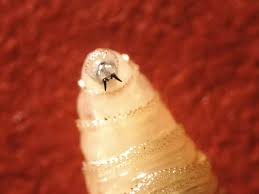
Most Americans have probably never heard of the New World screwworm and, judging by the name, would be forgiven for thinking it was the title of an adult film rather than a flesh-eating parasite capable of causing billions of dollars in damage to America’s livestock industry.
Unfortunately, the screwworm is very real.
This parasite’s larvae burrow into the living tissue of cattle, wildlife, pets, and sometimes even people, literally eating their hosts alive from the inside out. Unlike most fly larvae, which feed on dead or decaying tissue, screwworm larvae consume healthy living flesh. A single fertilized female can lay hundreds of eggs in an open wound, and the resulting larvae can rapidly expand the infestation as they feed, creating larger wounds that attract still more egg-laying females. Left untreated, animals can suffer severe infections, mutilation, and death. It is this uniquely destructive life cycle that makes the screwworm one of the most feared livestock pests in the world.
Before its eradication from the United States in the 1960s, screwworm infestations caused immense suffering to animals and imposed staggering costs on ranchers and farmers across the American South and Southwest.
For decades, the United States led one of the most successful biological control campaigns in history. By releasing billions of sterile male screwworm flies—the adult form of the parasite whose flesh-eating larval stage is known as the screwworm—federal and international partners drove screwworm populations out of the United States and then progressively southward through Mexico and Central America. The effort required sustained collaboration among the United States, Mexico, Panama, and numerous other Latin American governments over many decades. More than just protecting its own borders, the United States helped establish a moving biological barrier that pushed the parasite farther and farther south, ultimately creating a containment zone in Panama that helped protect the entire region.
It was one of the great triumphs of twentieth-century biotechnology.
But today, the screwworm is returning.
Recent detections in Texas and New Mexico are a warning sign that a battle we thought we had largely won is far from over. Climate change, expanding trade networks, shifting ecological conditions, cross-border livestock movements, wildlife migration, human mobility, decreased international collaboration, and other factors are creating new opportunities for pests and pathogens to spread. The result is that the United States now faces a growing threat to its livestock industry, food security, and agricultural economy.
The economic stakes are enormous. Texas is the center of the American cattle industry, and experts estimate that a widespread screwworm outbreak could cost the state’s economy nearly $2 billion. Beyond the direct losses, ranchers could face mounting treatment costs, reduced herd sizes, lower productivity, disrupted livestock movements, and higher operating expenses. Consumers would likely see even higher beef prices. If screwworms become established across large portions of Texas and the American Southwest, what begins as a parasite problem could quickly become a food supply problem, disrupting cattle production, livestock movements, and regional agricultural markets.
If current containment efforts fail, the consequences could be severe. Large regions of the southern United States could once again experience recurring infestations. Ranchers would face rising costs for surveillance, treatment, and animal losses. Wildlife populations could suffer, beef production could decline, and a localized agricultural problem could morph into a significant national economic challenge.
In the worst-case scenario, an uncontrolled screwworm resurgence could spread across much of the southern United States, threatening millions of cattle, disrupting interstate livestock movements, increasing food prices, reducing exports, and forcing governments and ranchers to spend billions of dollars on containment and treatment. A severe outbreak could conceivably become one of the costliest agricultural pest crises in modern American history
The sterile insect technique remains one of our most important tools. It worked before and it can work again. We should continue expanding sterile fly production, strengthening surveillance systems, improving cross-border coordination, and investing in rapid response capabilities.
Texas deserves credit for recognizing the seriousness of the threat. Governor Greg Abbott has activated emergency response mechanisms, state agencies have increased surveillance and preparedness efforts, and federal officials are expanding sterile-fly production and response planning.
We should hope the traditional sterile-fly strategy succeeds, but prudence requires that we start preparing for the possibility that it may not.
In doing so, we should recognize that we may be entering a world in which yesterday’s solutions may no longer be sufficient for tomorrow’s challenges.
The forces driving the resurgence of screwworms are not temporary. Climate change is expanding the geographic range of pests and pathogens, global trade, migration, and transportation networks are moving organisms across borders at unprecedented scale, and human activity is reshaping ecosystems faster than many species can adapt.
Global warming is already expanding the geographic range of countless insects, pathogens, and invasive species, bringing them into contact with plants, animals, and ecosystems that have not evolved defenses against them. Because these shifts are occurring over decades rather than millennia, natural evolutionary adaptation often cannot keep pace, creating new vulnerabilities for agriculture, wildlife, and human health alike.
That is why we must begin actively considering a more powerful set of tools for fighting back the New World screwworms, including the possibility of deploying gene drives.
As I detailed in my book Superconvergence, gene drives represent one of the most consequential biotechnology platforms ever developed. Unlike conventional genetic modifications, gene drives alter the rules of inheritance themselves, allowing engineered traits to spread rapidly through populations over successive generations.
In simple terms, a gene drive works by ensuring that an engineered genetic trait is inherited by nearly all offspring rather than the roughly fifty percent expected through normal inheritance. As a result, a genetic change introduced into a relatively small number of organisms can spread through an entire population over time. Scientists have already demonstrated this capability in laboratory studies involving mosquitoes and other species.
The remarkable feature of gene drives is that they harness the power of exponential growth. Instead of requiring the release of billions of sterile flies year after year, a relatively small number of gene-drive-modified screwworms could spread the engineered trait throughout an entire population as each generation passes it to nearly all of its offspring. Over time, the engineered trait could become dominant across the population.
Applied to screwworms, gene drives could be designed to spread traits that render females sterile, bias offspring toward males, or otherwise suppress reproduction, alter traits critical to survival, and drive local populations toward collapse.
A successful gene-drive strategy could help protect cattle herds and other domesticated and wild animals, reduce economic losses, decrease the need for insecticides, strengthen food security, and potentially provide a long-term solution rather than a perpetual holding action.
But the potential risks of deploying gene drives are also significant.
All ecosystems are far more complex than we understand, so massive humility must be our starting point. Gene drives could conceivably spread beyond their intended target populations or have unintended ecological consequences. They could reduce genetic diversity or harm ecosystems in unexpected ways. Once released, they could be difficult or impossible to reverse completely. As with many transformative technologies, the potential benefits are enormous but so are the potential costs of failure.
Because the concerns about gene drives in any context are very real, they must be taken extremely seriously.
As I describe in Superconvergence, the African Union spent years conducting a comprehensive review of the potential use of gene drives to combat malaria, one of humanity’s oldest and deadliest diseases that still kills hundreds of thousands of Africans each year. Following extensive scientific, regulatory, ethical, and public consultations, the African Union’s High-Level Panel on Emerging Technologies concluded that Africa should invest in the development and governance of gene-drive technologies and, in a 2025 update, concluded that the responsible course was neither immediate deployment nor blanket rejection, but rigorous scientific evaluation paired with extensive public engagement and governance planning.
That is precisely the kind of conversation we in the United States now need to be having about the potential application of gene drives for pushing back the New World screwworms.
Uruguay and other countries are already exploring whether gene drives may eventually play a role in combating screwworms. The United States does not need to reach any conclusions today, but we should be undertaking the same rigorous scientific, regulatory, and public review processes now so that we are prepared if circumstances ultimately demand more aggressive interventions.
Our most important work today, in other words, is not deploying gene drives to defend our agriculture and ecosystems against New World screwworms. We may not be ready for that. Our most important work today is ensuring that if the current outbreak grows into a larger crisis, we will have already done the scientific, ethical, regulatory, and public-engagement work necessary to make wise and publicly accepted decisions.
That means bringing ranchers, farmers, scientists, environmental organizations, policymakers, ethicists, Indigenous communities, and citizens into a broad public conversation about both risks and opportunities, developing transparent regulatory frameworks, conducting rigorous ecological assessments, establishing national and international standards, funding independent oversight, and creating mechanisms for meaningful public participation, building trust, creating norms, and establishing institutions capable of making wise decisions before a crisis forces our hand.
Because we need these educational, engagement, and governance systems in place before any final decision can be made, best to start building them now.
Some critics argue that using gene drives would represent an unacceptable intrusion into nature. While I deeply respect that perspective, this argument often mischaracterizes the world we actually inhabit.
Agriculture is not untouched nature. It is one of humanity’s oldest and most profound applications of biotechnology. Every modern crop, every domesticated animal, every managed pasture, and every cattle ranch reflect thousands of years of human intervention. Applying advanced biotechnology to modern agriculture is not biotechnology acting upon pristine nature, but biotechnology acting upon systems that have already been shaped by agriculture, biotechnology, climate change, and human activity for millennia.
The question before us is therefore not whether humans should intervene in nature. We already do. It’s whether we can learn to intervene as minimally, wisely, and safely as necessary and possible.
The screwworm challenge is a preview of a future in which humanity will possess increasingly powerful abilities to reshape biological systems, ecosystems, and even evolution itself. As I’ve described elsewhere, similar questions are arising in artificial intelligence, synthetic biology, human genome editing, and many other transformative technologies.
The essential challenge is essentially the same in all of these domains: How do we harness powerful new technologies for the common good while minimizing their risks and respecting the majesty of nature more broadly?
In all of these areas, the answer is generally neither blind enthusiasm nor blanket prohibition. It is thoughtful, transparent, adaptive governance grounded in rigorous science, broad public engagement, and a commitment to ensuring that our most powerful technologies serve humanity’s highest values.
—
About Jamie Metzl
Jamie Metzl is a leading AI keynote speaker, technology futurist, bestselling author, and former National Security Council official. The author of The AI Ten Commandments, Superconvergence, Hacking Darwin, and other books, Jamie helps organizations understand and navigate the profound transformations being driven by artificial intelligence, biotechnology, genetics, and other exponential technologies.
A globally recognized expert on AI, innovation, human flourishing, and the future of humanity, Jamie’s keynote presentations explore how leaders, organizations, and societies can harness powerful emerging technologies while remaining grounded in enduring human values. His audiences include Fortune 500 companies, healthcare organizations, universities, government agencies, industry associations, and global conferences seeking insight into AI strategy, the future of work, responsible innovation, and the opportunities and challenges of the Human + AI age.