

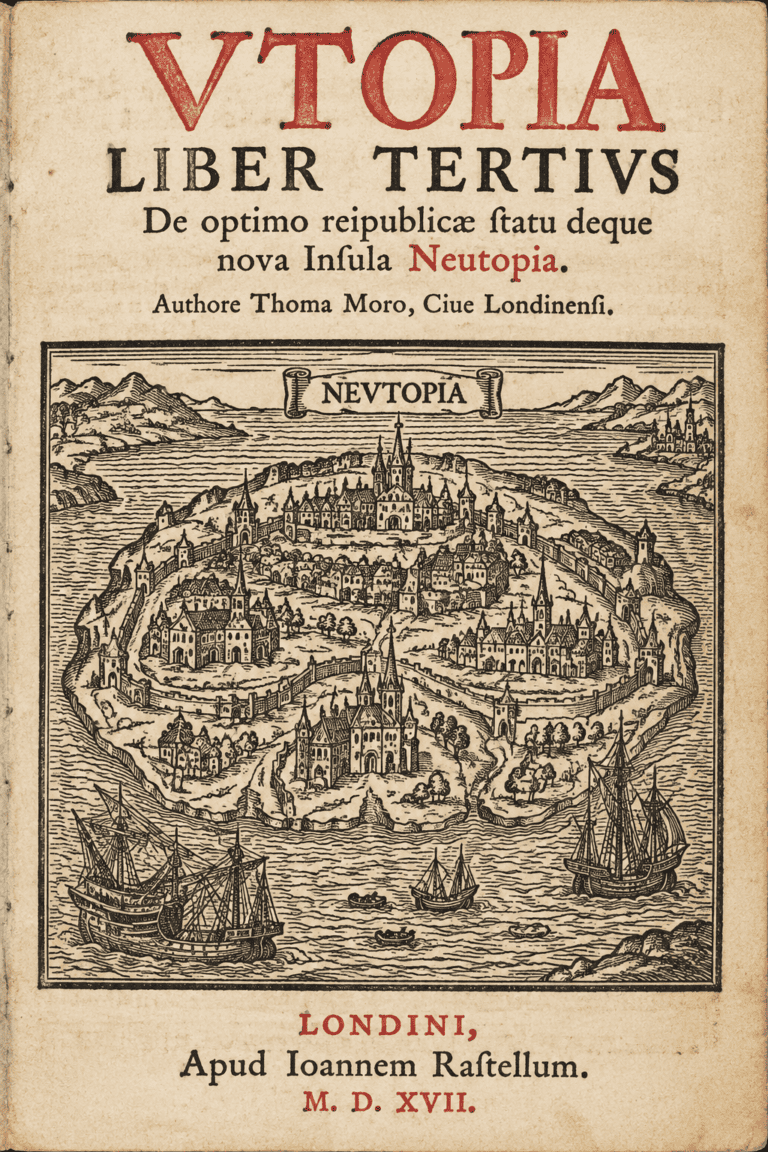
A bit more than five centuries ago, the Western world was facing convulsions even greater than our own today.
Europeans had reached the Americas less than a quarter century earlier, opening their minds to unfamiliar societies and new possibilities, while the printing press was expanding access to knowledge and enabling more people to question established authority. Growing commercial connections carried goods and ideas across borders, while the recovery of ancient learning, preserved and developed in part by scholars in the Islamic world had helped fuel the Renaissance. Christianity was also on the threshold of upheaval. In 1517, Martin Luther challenged Church authority with his famous Ninety-five Theses, helping launch the Protestant Reformation.
It was in this context that Thomas More published Utopia in 1516. Part political philosophy, part satire, and part exercise in radical imagination, the book challenged readers to reconsider many of the assumptions underlying European society. Divided into two parts, Book I explored the injustices and absurdities of contemporary England and Europe, including poverty, inequality, political corruption, and the harsh punishment of criminals. Book II described the fictional island of Utopia, where private property had been abolished, everyone worked just six hours a day, and education, healthcare, and basic necessities were available to all. But the Utopians also lived under an extraordinarily intrusive government that regulated everything from travel and marriage to personal behavior, and even permitted slavery.
The book was More’s tongue-in-cheek response to the radical changes transforming his world and an opportunity to imagine an entirely different society while poking fun at the absurdities of his own. More was also having a bit of fun at everyone’s expense, including his readers. The surname of his narrator, Raphael Hythloday, roughly translates from the Greek as something like “dispenser of nonsense.”
As our own world convulses through another period of radical transformation, I’ve been thinking a lot about More and his sixteenth-century project. That got me wondering what might have happened if More had written a third book in 1517, one that was lost for five centuries before being rediscovered in a dusty box in a London basement. In this imagined sequel, Hythloday learns of a group of people who had grown increasingly frustrated with the authoritarian restrictions and injustices of Utopia and fled across the mountains to establish a new commonwealth called Neutopia. There, they sought to preserve the best of what they had inherited while correcting its worst failings and imagining a better future.
What follows is my collaboration with GPT-6.1 in pursuit of that mission. I have attempted to imagine what More’s fictional society might have looked like had its founders placed greater emphasis on individual liberty, human dignity, democratic accountability, scientific progress, and the balance between personal freedom and collective responsibility.
For anyone interested in exploring the original work, here’s a link to the full text of Utopia, Book II. To make things easier, I have also included a detailed summary in Section I below. In Section II, I’ve listed the central attributes of More’s Utopia, followed in each case by my proposed modern reinterpretation. Finally, in Section III, I present the newly “discovered” Book III of Utopia, complete with a Borges-inspired author’s note describing the mysterious circumstances of its recovery.
I have no particularly convincing explanation for why I felt inspired to undertake this eccentric project, but perhaps revolutionary times naturally inspire creative thinking. Whatever the (flimsy) explanation, I had a lot of fun imagining this alternative world and hope exploring it brings you a little extra joy (and maybe inspired a few extra thoughts) as well.
SECTION 1: A SUMMARY OF BOOK II OF THOMAS MORE’S UTOPIA (1516)
[FUN FACT: THE FULL TITLE OF THE BOOK IS: “Utopia, The Discourse of Raphael Hythloday on the Best State of a Commonwealth, Book Two: As Recounted by Thomas More, Citizen and Sheriff of London.”]
Introduction
Published in 1516, Thomas More’s Utopia is one of the most influential works of political philosophy and social imagination in Western history. Written during the Renaissance, when European societies were undergoing significant intellectual, religious, economic, and political changes, the book challenges readers to reconsider many of the assumptions underlying their institutions. More asks what a society might look like if its inhabitants organized their collective lives around principles very different from those prevailing in sixteenth-century Europe.
The book is divided into two parts. Book I examines the problems of contemporary European society, including poverty, inequality, political corruption, harsh criminal punishments, and the concentration of property and power. Book II describes a fictional island whose inhabitants have developed an alternative social order. Through the account of Raphael Hythloday, an imaginary traveler who claims to have visited Utopia, More presents an extraordinarily detailed description of its government, economy, families, religion, educational institutions, healthcare system, foreign relations, and everyday life.
Many of Utopia’s arrangements remain striking even five centuries later. Its inhabitants have abolished private property, eliminated money from most domestic transactions, established a six-hour working day, guaranteed access to basic necessities, and made education and intellectual development central features of ordinary life. Their society seeks to discourage excessive consumption, political corruption, economic exploitation, and the accumulation of wealth for its own sake. In several respects, More imagines arrangements that anticipate much later debates about economic justice, universal healthcare, the distribution of work, and the relationship between material prosperity and human happiness.
Yet Utopia also has deeply troubling characteristics. Its inhabitants face extensive restrictions on travel, marriage, sexuality, and political activity. Families are organized along patriarchal lines, slavery is an accepted institution, and the government exercises considerable authority over personal behavior. Although the Utopians profess to despise war, they sometimes employ mercenaries, assassination, bribery, and coercive colonization. The apparent harmony of their society rests partly on a level of regulation that modern readers would find oppressive.
These contradictions are essential to understanding the book. More was a sophisticated Renaissance humanist who employed satire, irony, and philosophical experimentation to challenge his readers. The name Utopia itself suggests “no place,” and Hythloday’s name carries associations with nonsense or idle talk. More deliberately creates uncertainty about whether the island should be understood as an ideal society, a warning about excessive social regulation, a critique of European civilization, or a combination of these possibilities. Book II is most rewarding when read as an invitation to consider which elements of society are necessary, which are the products of historical choices, and how human institutions might be organized differently.
- The Island of Utopia and Its Physical Organization
More begins Book II with a description of Utopia’s geography and history. The island is approximately 200 miles across at its widest point and has a crescent shape that creates a large, sheltered harbor. Its geography makes it suitable for agriculture, transportation, and trade while also providing significant defensive advantages. The entrance to the harbor is difficult for outsiders to navigate without assistance from local inhabitants, helping protect the island against invasion.
According to Hythloday, Utopia was not always an island. It was originally connected to the mainland until a conqueror named Utopus defeated its inhabitants and ordered a channel dug through the land connecting the territory to the continent. The project required enormous collective effort, but it succeeded in transforming the conquered territory into an island. This founding story establishes an important theme running throughout Book II: Utopian society has been deliberately constructed through human decisions and coordinated action.
The island contains 54 cities, all governed by essentially the same laws and organized according to similar social and economic principles. The cities are distributed across the island so that their residents can travel between them relatively easily, and the surrounding countryside provides agricultural resources. Although each city manages many of its own affairs, representatives gather regularly to coordinate matters affecting the island as a whole.
The capital, Amaurot, is located near the center of the island and serves as the principal meeting place for representatives from the other cities. Hythloday describes it as a well-planned urban environment with orderly streets, substantial buildings, public facilities, and carefully cultivated gardens. Its streets and neighborhoods have been designed with attention to convenience, hygiene, and the needs of its inhabitants.
One particularly striking feature is the absence of private ownership of houses. Citizens live in comfortable residences, but these homes belong to the community rather than to particular individuals or families. Every ten years, households exchange houses by lottery, preventing permanent claims to especially desirable properties. More presents this arrangement as part of the larger effort to eliminate the accumulation of private wealth and discourage social distinctions based on material possessions.
The gardens behind the houses are cultivated enthusiastically, and residents take pride in their beauty and productivity. Gardening provides food, recreation, and an opportunity for friendly competition among neighbors. This relatively minor detail is revealing because it demonstrates that More does not imagine the elimination of every form of personal ambition or competition. The Utopians can still take pleasure in accomplishment, craftsmanship, and beauty, provided these activities contribute to the community rather than creating destructive differences in wealth or status.
- Government, Elections, and Political Authority
Utopia is governed through a system of elected officials and representative institutions designed to distribute political responsibility while discouraging corruption and tyranny. Each city is divided into groups of households, with thirty households electing a local official known as a syphogrant, sometimes translated as a phylarch. Groups of ten syphogrants are supervised by a higher official called a tranibor, or senior phylarch. This structure connects individual households to larger political assemblies and provides a mechanism for coordinating public affairs.
Each city also has a chief magistrate, sometimes translated as a prince, who is selected through an indirect election. The population identifies candidates, and the syphogrants choose among them by secret ballot. The chief magistrate serves for life unless he is suspected of seeking tyrannical power, in which case he can be removed. More combines continuity in executive leadership with mechanisms intended to prevent the emergence of an absolute ruler.
Political decisions are supposed to result from careful consideration rather than impulsive action. Important matters are discussed in official councils, and major questions may be referred to the larger assembly of representatives. More describes rules requiring certain proposals to be considered over multiple meetings before decisions can be made. The Utopians believe that delaying important decisions encourages more thoughtful deliberation and reduces the risk that persuasive individuals will manipulate assemblies into acting rashly.
The system also contains safeguards against political conspiracies. Public business is supposed to be discussed through established institutions, and private political deliberations outside authorized assemblies can be punished severely, even by death. The Utopians regard such restrictions as protections against secret factions and attempts to overthrow the political order, but they also reveal the authoritarian dimensions of a society that otherwise places considerable emphasis on public accountability.
The Utopians believe that political leadership should be understood as a form of public service. Officials are expected to administer communal resources responsibly, encourage productive activity, and maintain institutions that support the welfare of the population. Because private wealth plays little role in domestic life, the opportunities for enriching oneself through public office are significantly reduced.
More’s political system thus combines several principles that remain familiar today, including elected representation, institutional checks on executive power, procedural safeguards, and concern about corruption. At the same time, its restrictions on political discussion and acceptance of severe punishments demonstrate that Utopian notions of collective order and political stability take precedence over many freedoms central to modern liberal democracy.
- Private Property, Money, and Economic Organization
The abolition of private property is perhaps the most radical and consequential feature of Utopian society. Land, houses, and productive resources belong to the community rather than to individuals. The Utopians believe that private ownership encourages greed, rivalry, inequality, and the pursuit of wealth at the expense of more important human purposes. By eliminating private property, they hope to remove many of the incentives that produce poverty, corruption, and social conflict.
Goods are produced through an organized system of agriculture and manufacturing and then distributed through communal warehouses and markets. Households obtain what they need without paying for it, and domestic economic life operates largely without money. Hythloday claims that people generally refrain from taking more than they require because they know their future needs will also be met. The security provided by the community is supposed to reduce the fear and acquisitiveness that encourage hoarding.
The arrangement eliminates many forms of economic insecurity that were common in sixteenth-century Europe. Utopians do not fear starvation because they cannot afford food, eviction because they cannot pay rent, or abandonment when they become too old or sick to work. Their basic material needs are provided through collective arrangements, and the society considers such security a fundamental objective of economic organization.
More also challenges the social prestige attached to wealth. Gold and silver, which European societies treat as symbols of status and power, are deliberately assigned degrading uses in Utopia. They are made into chamber pots and chains for enslaved people, while precious stones are used as ornaments by children who eventually outgrow their fascination with them. The purpose is to expose what the Utopians consider the absurdity of allowing rare but relatively useless materials to determine social standing.
The Utopians nevertheless recognize that money has practical value in dealing with other societies. They maintain reserves of gold and silver acquired through trade, which can be used to purchase foreign goods, pay mercenaries, or finance military campaigns. Their rejection of money is therefore primarily an internal social arrangement rather than an absolute refusal to participate in international commerce.
The underlying economic argument is that human welfare should be the principal objective of production and distribution. Rather than organizing society around the indefinite accumulation of private wealth, the Utopians seek to ensure that everyone has enough while discouraging wasteful consumption. More challenges the assumption that extreme disparities of wealth are necessary to motivate economic activity or support a sophisticated civilization.
- The Six-Hour Workday and the Meaning of Labor
One of the most remarkable features of Utopia is its six-hour working day. Citizens ordinarily work for three hours in the morning and another three hours in the afternoon, leaving considerable time for meals, rest, education, recreation, and personal activities. More presents this arrangement as entirely compatible with providing the goods and services necessary for a comfortable life.
The Utopians achieve this by expecting nearly every able-bodied person to contribute productive labor. Hythloday contrasts their system with European societies in which large numbers of aristocrats, wealthy landowners, servants, religious figures, and others do little work while a smaller population of laborers supports them. He also argues that much of the work performed in Europe serves the production of unnecessary luxuries or the maintenance of elaborate social hierarchies.
By eliminating many occupations regarded as unproductive and discouraging excessive consumption, Utopia can distribute necessary labor among a much larger share of the population. As a result, individual working hours can be reduced without creating shortages. Hythloday suggests that a society organized around genuine human needs requires far less labor than one devoted to satisfying limitless desires for status and luxury.
Every citizen learns agriculture and participates in farming at some point. In addition, each person receives training in a practical trade, such as weaving, carpentry, metalworking, or masonry. Individuals may follow the trade practiced by their families or move to another household to learn a different occupation. The system provides some opportunities to pursue individual interests while ensuring that essential work is performed.
Public officials supervise labor and discourage idleness, but they are also expected to prevent unnecessary overwork. More emphasizes that the purpose of the system is to create conditions in which people can enjoy meaningful lives rather than spend nearly all their waking hours producing material goods. Leisure is regarded as an opportunity for intellectual development, social relationships, and activities that contribute to human flourishing.
This conception of labor remains one of the book’s most provocative ideas. More asks readers to consider whether economic progress should be measured primarily by increasing production and consumption or by improving the quality of human life. If a society becomes sufficiently productive to meet its needs with less work, its members might reasonably choose to devote more time to education, creativity, relationships, and other pursuits.
There is, however, an important qualification. Some particularly unpleasant work is performed by enslaved people, including the slaughter of animals. Utopia’s apparent abundance of leisure among free citizens therefore depends partly on a coercive labor system that contradicts its broader commitment to equality.
- Agriculture, Food Security, and the Relationship Between Cities and the Countryside
Agriculture is essential to Utopian life, and the society makes a deliberate effort to ensure that all citizens understand the work required to produce food. The countryside is organized around agricultural households, which cultivate the land and supply food to nearby cities. These rural communities include both permanent residents and people who have temporarily relocated from urban areas to perform agricultural service.
Citizens generally spend two years working in the countryside, although some choose to remain longer because they enjoy rural life. The rotation distributes agricultural labor across the population and prevents the emergence of a permanently subordinate class of farmworkers. It also ensures that urban residents remain familiar with the natural systems and practical activities on which their lives depend.
Agricultural production is carefully coordinated. Communities aim to produce sufficient food for their populations while maintaining reserves against shortages or emergencies. Surpluses are distributed to other cities or exported to foreign markets. The organization of production reflects the Utopians’ larger conviction that essential resources should be managed according to collective needs rather than the profit motives of individual landowners.
More’s description also suggests a society in which the distinction between urban and rural populations is less pronounced than in much of contemporary Europe. Citizens participate in both forms of life, and the movement between them encourages a shared sense of responsibility. Agricultural work is treated as an essential contribution to society rather than an occupation associated with inferior status.
The system is designed to prevent food insecurity while maintaining relatively simple patterns of consumption. In this respect, More anticipates later discussions about collective responsibility for essential resources and the importance of organizing economic systems around basic human needs.
- Families, Marriage, and the Regulation of Personal Life
Although Utopia rejects many economic hierarchies, it retains a strongly patriarchal social structure. Households are generally governed by the oldest male, and family relationships are organized according to expectations of deference to age and authority. Wives are expected to respect their husbands, children their parents, and younger people their elders. More’s imagined society therefore preserves important elements of the traditional social organization of his own time.
Families also serve administrative and economic purposes. Households are expected to remain within preferred population ranges, and individuals may be transferred between households when some become too large and others too small. Similar adjustments occur between cities, with residents moved to maintain what the Utopians consider an appropriate distribution of population and resources. Personal choices about where to live are consequently subordinated to broader social planning.
Marriage is closely regulated. Women may marry at eighteen and men at twenty-two, and sexual relations before marriage are prohibited. The Utopians regard premarital sexuality as a serious offense because they believe it threatens stable family relationships. They maintain similarly strict expectations regarding fidelity after marriage.
One of the book’s strangest customs requires prospective spouses to inspect one another naked before marriage, under the supervision of appropriate attendants. The Utopians justify this by observing that people carefully examine animals before purchasing them and should be at least as careful when choosing a lifelong partner. More uses this unusual arrangement to illustrate the Utopians’ commitment to rational decision-making, even when it leads to practices that appear intrusive or absurd.
Divorce is permitted in limited circumstances, including adultery and serious incompatibility, but requires official approval. Adultery is punished particularly harshly, with enslavement generally imposed for a first offense and the possibility of execution for repeated violations. These penalties reveal how extensively the government intervenes in matters that modern societies generally regard as belonging primarily to individual conscience and private life.
The Utopians consider family stability important to the welfare of the community, but their efforts to preserve it involve substantial limitations on personal autonomy. More’s account therefore raises questions about how societies should balance shared moral expectations with individual freedom and whether the pursuit of social harmony can become a justification for excessive control.
- Daily Life, Clothing, Meals, and Recreation
Everyday life in Utopia is organized around simplicity, regularity, and communal participation. Citizens wear practical clothing that varies relatively little according to fashion or social status. The Utopians regard elaborate dress as a waste of labor and resources, and they discourage the use of clothing or personal possessions to demonstrate wealth or superiority.
Meals are generally taken in communal dining halls, where households gather according to established arrangements. Older citizens receive particular respect, and seating often reflects age and family relationships. Food is prepared and served through organized communal arrangements, although individuals are permitted to eat at home if they prefer. The social structure makes communal dining the usual practice and encourages regular interaction among neighbors.
These shared meals are intended to reinforce community relationships and discourage social isolation. They also make food distribution more efficient and reduce some of the domestic labor that would otherwise be required in individual households. The Utopians regard conversation, fellowship, and mutual respect as important parts of daily life.
Recreation is relatively simple. Citizens enjoy reading, music, intellectual discussion, and games, while generally avoiding gambling and activities associated with cruelty or excessive consumption. The Utopians seek pleasures that contribute to health, friendship, and the cultivation of the mind rather than those intended primarily to display wealth or encourage competition for status.
More imagines a society in which people possess relatively few personal luxuries but enjoy substantial economic security, leisure, and opportunities for social interaction. The simplicity of everyday life is intended to support the larger objective of creating a community in which material possessions occupy a less central place in defining individual success and happiness.
- Education, Scholarship, and Intellectual Development
Education occupies a central position in Utopian society. Both men and women receive instruction, and the Utopians regard learning as an important part of a good life rather than merely preparation for employment. Their economic arrangements are designed partly to ensure that ordinary citizens have sufficient leisure to pursue intellectual interests.
Public lectures are offered regularly, often early in the morning before the working day begins. Attendance is generally voluntary, but many people participate because intellectual development is highly valued. The Utopians study subjects including mathematics, astronomy, logic, music, and moral philosophy, and they show considerable interest in the scientific and philosophical achievements of other cultures.
Hythloday is particularly impressed by their eagerness to learn about Greek literature and philosophy. When he and his companions introduce classical texts and other elements of European intellectual culture, the Utopians quickly develop an appreciation for them. Their curiosity suggests that the society values knowledge as something that can be accumulated, shared, and continuously expanded.
Certain individuals who demonstrate exceptional intellectual ability may be released from ordinary productive work to devote themselves more fully to study. These scholars may become teachers, priests, or public officials, and their achievements are respected by the broader community. Nevertheless, education is not restricted to a small elite. The system seeks to make learning a regular and rewarding part of ordinary life.
More connects education with citizenship and moral development. The Utopians believe that intellectual cultivation helps people exercise better judgment, appreciate meaningful pleasures, and contribute responsibly to society. They also recognize that knowledge can enrich personal life independently of its immediate economic usefulness.
The larger principle is that society should organize work and resources so that people have genuine opportunities to develop their abilities. More imagines a community in which education continues throughout adulthood and intellectual achievement is valued more highly than the accumulation of wealth.
- Happiness, Pleasure, and the Good Life
The Utopians devote considerable attention to understanding happiness and the relationship between pleasure and virtue. Their moral philosophy draws on classical traditions, particularly ancient discussions of reason, moderation, and the nature of a good life. They regard pleasure as an important human good but distinguish carefully between experiences that contribute to genuine well-being and those that provide temporary satisfaction while causing longer-term harm.
Physical pleasures include eating, drinking, bodily comfort, and the experience of good health. Mental pleasures include learning, understanding, contemplation, friendship, and the satisfaction associated with virtuous conduct. The Utopians place particular value on pleasures of the mind, although they also believe that physical well-being is essential to happiness.
Health receives special emphasis because freedom from pain and illness allows people to enjoy other dimensions of life. The Utopians do not equate pleasure exclusively with intense stimulation or excitement. They regard the quiet satisfaction of being healthy, intellectually engaged, and free from unnecessary suffering as among the greatest pleasures available to human beings.
Their philosophy nevertheless imposes moral limits on the pursuit of pleasure. People should not seek enjoyment at the expense of others or engage in activities that undermine their own long-term well-being. Reason and virtue are necessary to distinguish genuinely beneficial pleasures from those that appear attractive but ultimately produce suffering.
Religious beliefs reinforce this moral framework. Many Utopians believe in the immortality of the soul and in rewards and punishments beyond death, providing an additional foundation for their conviction that virtue contributes to happiness. More presents the pursuit of a good life as inseparable from questions about personal conduct, obligations to others, and the organization of society.
The result is a philosophy in which happiness is a legitimate and important social objective, but one that cannot be reduced to material prosperity or unrestricted consumption. The Utopians believe that a good society should help people cultivate the intellectual, moral, physical, and social conditions necessary for genuinely satisfying lives.
- Healthcare, Hospitals, and Care for the Sick
Healthcare in Utopia is available to all inhabitants without payment at the point of treatment. Each city maintains four large hospitals located outside the main residential areas, allowing patients to receive medical attention in comfortable surroundings while reducing the risk of spreading contagious diseases. The hospitals are spacious, well organized, and equipped to care for people with different medical conditions.
Hythloday describes the quality of medical care as sufficiently high that sick people often prefer being treated in hospitals rather than at home. Patients receive appropriate food, attention, and accommodations, and the society considers their welfare a collective responsibility. Illness does not threaten a person’s access to basic necessities because the economic system provides support regardless of an individual’s ability to work.
The Utopians also care for elderly and disabled people who can no longer contribute to productive labor. The community accepts responsibility for supporting them, reflecting the broader principle that access to essential resources should not depend entirely on economic productivity.
More includes a particularly striking discussion of people suffering from incurable and extremely painful illnesses. In certain circumstances, priests and public officials may encourage such patients to consider voluntarily ending their lives. They argue that when suffering has become unbearable and recovery is impossible, death may offer release from misery. Patients are not forced to accept this recommendation, however, and those who refuse continue to receive care.
The Utopians distinguish between a death undertaken with appropriate religious and civic authorization and suicide without such approval. The latter is treated much more negatively, demonstrating that even decisions about the end of life remain subject to communal moral expectations.
These arrangements anticipate modern debates about universal healthcare, public responsibility for vulnerable people, medical ethics, and assisted dying. They also reveal the extent to which Utopian society attempts to reconcile compassion for individuals with collective judgments about appropriate conduct.
- Travel, Privacy, and Social Supervision
Freedom of movement is restricted in Utopia. Citizens who wish to travel to another city must obtain permission from public officials, and travelers receive documentation authorizing their journeys. They are expected to follow established itineraries and comply with local arrangements governing accommodation and work. Unauthorized travel can result in punishment, while repeated violations may lead to enslavement.
The Utopians justify these restrictions partly through their economic system. Because necessities are provided communally, they believe individuals should not be allowed to abandon their responsibilities while continuing to consume resources produced by others. Travel regulations are intended to ensure that labor remains properly distributed and that people contribute to the communities supporting them.
The restrictions also reflect a broader commitment to social supervision. Citizens generally eat in communal dining halls, work within organized systems, and live in households subject to public regulation. These arrangements reduce opportunities for private conduct and make individual behavior more visible to the community.
The Utopians believe that this visibility discourages idleness, misconduct, and antisocial behavior. From their perspective, public supervision helps preserve the cooperation and discipline on which their social arrangements depend. However, the result is a society in which personal autonomy and privacy are significantly restricted.
This is one of the central tensions in Book II. Utopia provides economic security, education, healthcare, and leisure while denying citizens many freedoms that modern readers regard as fundamental. More invites us to consider how far a society should go in regulating individual behavior to achieve collective goals and whether excessive supervision can undermine the very human flourishing it is intended to promote.
- Religion, Religious Tolerance, and Moral Conformity
Religious life in Utopia is more diverse and tolerant than in much of sixteenth-century Europe. The inhabitants follow several religious traditions, including forms of worship associated with natural forces, heavenly bodies, and different conceptions of divinity. Some worship a supreme being whom they understand as the ultimate source of existence, while others maintain different religious beliefs and practices.
According to Hythloday, Utopus established religious toleration partly because he recognized that religious conflict could undermine social unity. Citizens are permitted to follow their own religious traditions, provided they do not persecute others or attempt to impose their beliefs through violence and intimidation. People may try to persuade one another through reasoned argument, but aggressive religious coercion is prohibited.
This tolerance also reflects an element of philosophical humility. The Utopians recognize that human beings may not possess sufficient knowledge to determine with certainty which religious traditions are correct. They therefore allow substantial diversity of belief while encouraging respectful interaction among different religious communities.
When Hythloday introduces Christianity, some Utopians are attracted to its teachings, particularly its emphasis on communal responsibility and the sharing of possessions. Christianity is presented as compatible with several important Utopian principles, although More does not suggest that the island’s entire population immediately converts.
Religious freedom nevertheless has significant limits. People who deny the immortality of the soul or divine providence are regarded with suspicion because the Utopians believe such views may undermine moral responsibility. Although people are not automatically punished merely for holding these beliefs, they are excluded from public honors and positions of trust.
The Utopians therefore distinguish between religious diversity that can coexist with their shared moral framework and beliefs they consider threatening to that framework. Their society demonstrates considerable religious tolerance by the standards of More’s time, but it does not embrace the modern principle that people should enjoy equal civic rights regardless of their religious or nonreligious convictions.
- Priests, Religious Institutions, and Public Morality
Utopia has relatively few priests, but they enjoy substantial public respect. Priests are selected for their moral character and are expected to serve as examples of virtuous conduct. Their responsibilities include religious instruction, participation in ceremonies, the moral education of children, and guidance on ethical questions affecting the community.
Their authority is primarily spiritual and moral rather than political, although their influence extends into public life. The Utopians believe that religious leaders should encourage good conduct through persuasion, teaching, and personal example. Priests are expected to help citizens cultivate the values necessary for an orderly and cooperative society.
Women may become priests, although such appointments are uncommon and generally involve older women, particularly widows. This provision is striking in the context of sixteenth-century European religious institutions, even though Utopia retains patriarchal arrangements in many other areas.
Public religious ceremonies emphasize elements of worship that people from different traditions can share. Religious buildings and services are organized to accommodate diverse beliefs, reflecting the society’s effort to promote unity without requiring absolute uniformity of religious practice.
At the same time, religious institutions help sustain Utopia’s strong expectations about moral behavior. Religion contributes to the social framework through which citizens are encouraged to subordinate selfish desires to broader communal responsibilities.
- Slavery, Crime, and Punishment
Despite its commitment to economic equality among free citizens, Utopia maintains a system of slavery. This is one of the most disturbing contradictions in More’s imagined society. Enslaved people perform difficult and unpleasant work, and the existence of forced labor contributes to the comfort and leisure enjoyed by the free population.
The enslaved population includes Utopian citizens convicted of serious crimes, certain foreigners condemned for crimes elsewhere, and impoverished foreigners who voluntarily enter servitude under different arrangements. These categories do not all receive identical treatment. Citizens enslaved as punishment are generally treated more harshly because their offenses are considered particularly serious, while foreigners who voluntarily enter servitude may sometimes leave.
Slavery is presented partly as an alternative to execution. The Utopians argue that offenders who perform useful labor can contribute to society while having an opportunity to reform their behavior. Some enslaved people may eventually be released if they demonstrate repentance and improvement. Nevertheless, the system involves coercion, severe restrictions on liberty, and the treatment of human beings as instruments of collective economic benefit.
The criminal justice system also permits harsh punishments for serious offenses. Adultery can result in enslavement, while repeated violations may lead to execution. Certain political offenses and other serious crimes are likewise subject to severe penalties.
More’s treatment of slavery illustrates the limits of the Utopians’ commitment to universal human dignity. Their society eliminates extreme economic inequality among free citizens but continues to rely on an institution that fundamentally denies equality and freedom to others.
This contradiction is especially important because it challenges readers to consider whether a society can legitimately describe itself as just when its prosperity depends partly on the coercion of people excluded from its system of rights and protections.
- War, Military Strategy, and the Use of Force
The Utopians regard war as a regrettable and shameful activity rather than a source of glory. They do not celebrate military conquest for its own sake and believe that peaceful relations are preferable whenever possible. Hythloday contrasts their attitude with European aristocratic cultures in which warfare often provides opportunities for personal prestige, territorial expansion, and political ambition.
Nevertheless, Utopia maintains military capabilities and is willing to fight when its leaders believe war is justified. Acceptable reasons include defending the island, protecting allies, responding to aggression, and liberating oppressed peoples. The Utopians may also intervene to punish serious wrongs committed against friendly nations.
Their methods of warfare can be ruthless. Rather than seeking glory through direct combat, they prefer strategies that achieve victory while minimizing casualties among their own citizens. These methods include bribery, encouraging political divisions within enemy governments, offering rewards for the capture or assassination of opposing leaders, and hiring foreign mercenaries.
The Utopians make particular use of the Zapoletes, a people described by Hythloday as willing to fight for money. By employing mercenaries in dangerous military operations, Utopia reduces the risks faced by its own citizens. This practice reveals an uncomfortable distinction between the value the Utopians place on their own lives and their willingness to expose outsiders to extreme danger.
When direct military participation is necessary, Utopian citizens receive training and fight in organized forces. Women may accompany their husbands into battle, and the society places considerable importance on courage, discipline, and mutual loyalty. The Utopians nevertheless prefer victories obtained through negotiation, strategy, or manipulation when these methods can reduce the need for combat.
The overall picture is morally complicated. Utopia condemns war and military aggression while accepting methods that many readers would consider unethical. More exposes the difficulty of reconciling ideals of peace and justice with calculations about national security, military necessity, and the protection of one’s own population.
- Foreign Relations, Trade, and Colonization
Utopia maintains diplomatic, commercial, and military relationships with neighboring societies. Although money is largely absent from domestic economic life, the Utopians participate in international trade and accumulate reserves of gold and silver. These resources can be used to purchase scarce goods, support allies, and finance military operations.
The society distinguishes between different kinds of foreign relationships, including friendly states, military allies, and potential adversaries. Its foreign policy combines a stated commitment to justice with practical calculations about security and national interests.
Colonization reveals another significant contradiction. When Utopia’s population grows beyond what the island can comfortably support, groups of citizens establish settlements on the mainland. They seek territories they regard as insufficiently cultivated or used by existing inhabitants. If local populations accept the arrangements, Utopians may live alongside them, but resistance can lead to coercion or military force.
The Utopians justify this policy through their belief that land should be put to productive use. Yet the underlying assumption is that they possess the authority to determine whether another society is using its territory appropriately. This reasoning anticipates justifications later employed in European colonial expansion, when outside powers claimed the right to occupy lands inhabited by peoples whose agricultural and social practices differed from their own.
More therefore describes a society that seeks fairness and cooperation internally while sometimes applying very different standards to outsiders. The Utopians’ confidence in the superiority of their institutions can become a justification for imposing their preferences on others.
The contrast between domestic ideals and foreign conduct raises important questions about the limits of political morality. A society may sincerely believe that it is organized around justice while pursuing policies that deny other peoples the autonomy and respect it demands for itself.
- The Central Tension: Individual Freedom and the Common Good
The most important philosophical tension in Book II concerns the relationship between individual freedom and collective welfare. Utopia is designed to eliminate poverty, reduce economic insecurity, distribute necessary work fairly, promote education, discourage corruption, and create conditions in which citizens can enjoy healthy and meaningful lives.
Many of these objectives remain attractive. The inhabitants enjoy universal access to basic necessities, substantial leisure, opportunities for intellectual development, and relative economic equality. The society considers public welfare a central responsibility of government and organizes productive resources accordingly.
Yet the same institutional arrangements require extensive regulation of personal behavior. Citizens cannot freely travel between cities, choose their residences without restriction, organize political discussions outside authorized channels, or make many decisions about marriage and family life independently of public authorities. They are expected to conform to shared standards governing clothing, labor, social relationships, and public conduct.
The society therefore offers security and stability partly by reducing the range of choices available to individuals. More does not explicitly resolve whether these restrictions are necessary consequences of Utopia’s economic arrangements or evidence that its pursuit of collective harmony has gone too far.
This ambiguity is central to the work’s enduring appeal. Readers may admire the Utopians’ commitment to education and social welfare while rejecting their harsh punishments, intrusive regulation, and lack of political freedom. The book encourages a distinction between the objectives a society pursues and the methods it uses to achieve them.
More’s larger question concerns whether human institutions can be designed to promote the common good without granting governments excessive power over individual lives. Five centuries later, this remains one of the fundamental challenges of political philosophy and democratic governance.
- More’s Purpose and the Ambiguity of Utopia
Thomas More was a Renaissance humanist, lawyer, scholar, and statesman who participated in a period of profound intellectual and political change. He was deeply familiar with classical philosophy, Christian theology, contemporary European politics, and debates about the proper organization of society. Utopia reflects these influences while employing humor, irony, satire, and philosophical experimentation.
The title itself contains a deliberate Greek wordplay suggesting “no place,” while also evoking the idea of a good place. The name Raphael Hythloday similarly introduces uncertainty about the reliability of the book’s narrator. More uses these devices to complicate the relationship between the fictional society and his own beliefs.
Some readers have interpreted Utopia primarily as a serious critique of poverty, inequality, political corruption, and the harsh treatment of the poor. Others emphasize its satirical qualities, particularly the absurdities and contradictions of a society that seeks to regulate nearly every dimension of human behavior in the name of rational organization.
The book can support both interpretations. More’s description of common ownership, reduced working hours, education, and universal care for the sick provides a powerful challenge to the institutions of his own time. Yet his inclusion of slavery, severe punishments, restrictions on travel, and coercive foreign policies prevents readers from accepting the imagined society as an uncomplicated ideal.
At the conclusion of the work, More’s fictional persona expresses reservations about several Utopian institutions, particularly the elimination of private property. He nevertheless acknowledges that some Utopian practices seem desirable and worthy of consideration. The ending deliberately leaves the reader with an unresolved mixture of admiration, skepticism, and curiosity.
This uncertainty may be one of More’s most important achievements. By creating an imagined society that is both appealing and troubling, he encourages readers to evaluate particular institutions rather than accept or reject an entire political system. The exercise also reveals that arrangements considered natural or inevitable in one society may appear strange when viewed from another perspective.
- What Was Most Radical About Utopia?
Several features of Book II distinguish More’s imagined society from sixteenth-century Europe and remain significant today. Most fundamentally, he questions the assumption that private property and the pursuit of wealth must provide the organizing principles of economic life. His Utopians demonstrate, within the fictional world he creates, how communal ownership and coordinated production might provide economic security while reducing some of the inequalities associated with private accumulation.
The six-hour working day is equally striking. More imagines a society in which increased efficiency and the broad distribution of productive labor allow ordinary citizens to spend less time working. The additional leisure is intended to support education, friendship, recreation, and the cultivation of intellectual and moral capacities. He thereby raises questions about the purpose of economic progress and whether a prosperous society should measure success partly by the amount of freedom people have to pursue meaningful activities beyond work.
The commitment to universal access to necessities also represents a significant departure from the economic arrangements of More’s time. Utopia assumes collective responsibility for food, housing, healthcare, and the support of people unable to work. Economic insecurity is treated as a problem of social organization rather than simply an unavoidable feature of human existence.
Education is another central innovation. Both men and women receive instruction, and citizens are encouraged to pursue learning throughout their lives. Intellectual development is not confined to a small hereditary elite but is made available to ordinary people through the organization of work and public institutions.
More also introduces provocative ideas about political accountability, the regulation of luxury, religious tolerance, and the relationship between pleasure and virtue. His society is deliberately designed around a particular conception of human flourishing, demonstrating that political and economic institutions embody assumptions about what constitutes a good life.
At the same time, some of Utopia’s most distinctive institutions reveal the dangers of excessive social engineering. Restrictions on travel, intrusive marriage regulations, severe criminal punishments, and the use of enslaved labor illustrate how a society organized around collective goals may sacrifice individual rights and dignity. Its foreign policies reveal the additional danger of assuming that a society convinced of its own moral superiority is entitled to impose its arrangements on others.
The most enduring contribution of Book II may therefore be its demonstration that apparently attractive objectives can be pursued through deeply problematic means. More encourages readers to think seriously about both the benefits and costs of alternative institutions.
SECTION 2: COMPARING THOMAS MORE’S ORIGINAL UTOPIA, BOOK II VISION WITH JAMIE METZL’S PROPOSED UPDATES
- Government and Political Organization
- More’s original version: 54 cities. The island has 54 cities, all governed by essentially the same laws and institutions.
- Jamie’s proposed modern version: A federation of cities, each with its own customs and traditions, recognizing the need for a minimally necessary set of common rules and standards because of their interconnectedness and interdependence. The individual identities of the cities need to be balanced with their need to address shared challenges.
- More’s original version: Elected government. Households elect local officials, who participate in selecting higher officials.
- Jamie’s proposed modern version: Elections at all levels are direct, but voters must engage in educational activities to reach an agreed level of understanding of the issues being discussed. These educational materials are created in association with AI systems designed for maximal truthfulness, honesty, and impartiality. There is also an advisory council of experts at all levels. These councils are resolutely nonpolitical, by structure and culture. They do not have democratic decision-making powers, but can slow and challenge legislation to optimize the care and thoughtfulness of decisions. These experts serve for a single term, with no option for renewal.
- More’s original version: A ruler elected for life. Each city has a chief magistrate (often translated as prince), who serves for life unless suspected of aspiring to tyranny.
- Jamie’s proposed modern version: No rulers are elected for life. Each serves one five-year term, with the possibility of being elected for a second. There are no hereditary roles. Checks and balances are required among the institutions of government. No one in government has a lifetime role. Executive, judicial, and legislative branches exist. There are significant protections against tyranny by leaders and violent mobs. Leaders are accountable to the public. The traditional leadership model of Venice is an inspiration. Leaders serve the public.
- More’s original version: Representative institutions. Public decisions are made through elected councils, with safeguards against secret political conspiracies.
- Jamie’s proposed modern version: This is a good rule. Political processes have high degrees of transparency and accountability. Elections are publicly financed based on clearly established criteria. Structures are designed to encourage cooperation for the common good and avoid dangerous tribalism and division, while allowing meaningful differences to be negotiated.
- More’s original version: Strict limits on political discussion. Deliberating about public business outside authorized assemblies can be punished by death.
- Jamie’s proposed modern version: No limits on political discussion, but guidelines to help these conversations become more thoughtful and helpful. Public forums are thoughtfully organized and encouraged, as are frameworks for helping all people have thoughtful conversations across differences. The idea is that citizens have more in common with one another than they have differences, and that these differences can be negotiated through thoughtful exchange.
- More’s original version: Uniform laws. Laws are relatively few, simple, and understandable without professional lawyers.
- Jamie’s proposed modern version: Laws are clearly written and direct, with no extraneous provisions thrown in for political purposes. Laws are designed to clearly and effectively achieve their goals. Most laws have sunset provisions and requirements for regular review and updates to avoid having out-of-date laws on the books.
- More’s original version: No lawyers. Citizens generally represent themselves in legal disputes.
- Jamie’s proposed modern version: Lawyers exist, but the legal system is designed to be understandable and navigable by regular people. Those accused of crimes are entitled to full representation. The state cannot deprive anyone of their rights or liberty without due process. The system is run efficiently and fairly to avoid unnecessary delays.
- Economics, Property, and Labor
- More’s original version: No private property. Land, houses, and productive resources are held in common.
- Jamie’s proposed modern version: Some resources are held in common, such as parks and essential state infrastructure, but private property exists. Taxes and inheritance laws are designed to ensure that wealth and opportunity do not become overly heritable. Society is designed so that the most innovative and talented people of each generation can rise. The goal is equality of opportunity, but not necessarily of outcomes. No one can become so rich that they are above the law. Strong electoral laws ensure the equality of votes. Oligarchy and autocracy are resolutely avoided. Disparities of wealth and outcomes exist, but the state works to ensure that opportunity is as fairly distributed as possible.
- More’s original version: No money in domestic economic life. Citizens obtain necessities from communal storehouses without paying for them.
- Jamie’s proposed modern version: Money exists as a means of storing value. Investment helps generate future opportunity. Financial engineering with no positive societal goal is strongly disincentivized and discouraged.
- More’s original version: Common distribution. Goods are distributed according to need, with the expectation that people will not take more than necessary.
- Jamie’s proposed modern version: The state guarantees that no one falls below an agreed basic level of healthcare, housing, personal safety, food security, etc., while working to ensure that no one becomes overly dependent on state support or that reliance on state support does not sap motivation. There is no universal basic income, but lots of universal basic opportunity. No one feels discarded by society. No one feels overly entitled.
- More’s original version: Six-hour workday. People generally work three hours in the morning and three in the afternoon.
- Jamie’s proposed modern version: People work to achieve their goals. People are encouraged to learn and grow and to contribute meaningfully to society. As machines’ capabilities grow, our societal definition of what constitutes human work expands.
- More’s original version: Universal obligation to work. Every able-bodied adult is expected to perform productive labor, with exceptions for certain officials and scholars.
- Jamie’s proposed modern version: Everyone is encouraged to play a meaningful and productive role in society. The definition of what that means is broad.
- More’s original version: Agriculture for everyone. All citizens learn farming and spend periods working in the countryside.
- Jamie’s proposed modern version: All citizens are encouraged to spend time in nature and to learn about the ecosystems that sustain us and our responsibilities for sustaining them.
- More’s original version: Trade specialization. Citizens also learn a practical trade, such as weaving, carpentry, or metalworking.
- Jamie’s proposed modern version: All citizens are encouraged to uncover their unique capabilities and to incorporate those special skills into their lives. The state helps everyone find a productive place in a society that is broadly organized for the common good.
- More’s original version: No unemployment or idle aristocracy. The system seeks to eliminate socially unproductive occupations and ensure that everyone contributes.
- Jamie’s proposed modern version: This is a good idea.
- More’s original version: Limited luxury. Ostentatious consumption, expensive clothing, and displays of personal wealth are discouraged.
- Jamie’s proposed modern version: This is a good idea. People who want to invest in a useless status symbol like a diamond pin are encouraged to contribute the same value as that item to a highly efficient charitable organization.
- More’s original version: Gold is deliberately degraded. Gold and silver are used for chamber pots, chains for enslaved people, and other objects intended to undermine their prestige.
- Jamie’s proposed modern version: No need for chamber pots because we have modern plumbing. Silly displays of ostentatious wealth are discouraged.
- More’s original version: Communal dining. Citizens generally eat in large communal dining halls, although eating at home is permitted.
- Jamie’s proposed modern version: People can eat at home or in communal settings. Community is encouraged in many different contexts to help people feel that they are part of something bigger, a community in which they have connections, rights, and responsibilities.
- Family, Marriage, and Social Life
- More’s original version: Patriarchal households. Families are organized under the authority of the oldest male.
- Jamie’s proposed modern version: Families are organized however the families see fit. No one is forced into or out of gender roles. People are loved and accepted for who they are.
- More’s original version: Marriage regulations. Women may marry at 18 and men at 22.
- Jamie’s proposed modern version: All people may marry at the age of adulthood. Children are protected from abuse.
- More’s original version: Premarital sex is prohibited. Sexual relations outside marriage are treated as serious offenses.
- Jamie’s proposed modern version: People are allowed to make their own decisions about their bodies and sexuality.
- More’s original version: Prospective spouses inspect one another naked. Before marriage, each partner is shown the other unclothed to prevent unpleasant surprises.
- Jamie’s proposed modern version: People can be naked in their private lives however they see fit.
- More’s original version: Divorce is permitted under limited circumstances. Divorce may be authorized for adultery, intolerable behavior, or mutual agreement with official approval.
- Jamie’s proposed modern version: Divorce is permitted, as are other forms of partnership and separation.
- More’s original version: Adultery is severely punished. A first offense generally results in enslavement; repeated adultery can be punished by death.
- Jamie’s proposed modern version: Adultery is not punished by the state. People are encouraged to treat those in their lives with honesty and respect.
- More’s original version: Population management. Households and cities redistribute residents to maintain preferred population levels.
- Jamie’s proposed modern version: The state does not redistribute its citizens, but it does engage in thoughtful central planning to build infrastructure and provide support that enables and empowers people to live where there is space.
- More’s original version: Strict travel controls. Citizens need official permission to travel between cities; unauthorized travel is punished.
- Jamie’s proposed modern version: No travel controls. People are free to go where they please, provided they obey laws and are respectful to others. Private property is allowed.
- More’s original version: Uniform clothing. People wear simple, practical clothing that varies little by fashion or social status.
- Jamie’s proposed modern version: No uniform clothing. People are free to express themselves through their individual fashion. Art and creative expression are encouraged as both individual and collective goods.
- Education and Intellectual Life
- More’s original version: Universal education. Both men and women receive education.
- Jamie’s proposed modern version: Everyone receives a quality education. Students have the opportunity to function at the highest level of their abilities, in a system that encourages individual excellence but also stresses broader social cohesion.
- More’s original version: Learning is highly valued. Citizens are encouraged to devote their considerable leisure time to intellectual pursuits.
- Jamie’s proposed modern version: Good idea.
- More’s original version: Public lectures. Educational lectures are offered, including before the workday.
- Jamie’s proposed modern version: Public education is encouraged, continuously and at all levels. This is carried out by all sorts of organizations. People at all levels are encouraged to share their gifts with others.
- More’s original version: Scholars receive special status. Particularly talented citizens may be exempted from ordinary labor to pursue intellectual work.
- Jamie’s proposed modern version: Scholars and thinkers are highly valued but have the same social obligations as everyone else.
- More’s original version: Practical and philosophical learning. Mathematics, astronomy, music, logic, and moral philosophy are respected.
- Jamie’s proposed modern version: These and other topics are respected and encouraged. Education systems recognize both the importance of an educational canon and the need for inclusion so everyone feels they are part of the bigger societal story.
- More’s original version: Happiness as a philosophical goal. Utopians believe that pleasure, properly understood and governed by reason and virtue, is central to a good life.
- Jamie’s proposed modern version: Happiness is a goal, as are meaning, fulfillment, individual growth and expression, and strong communities tying everyone together.
- More’s original version: Health is especially valued. Physical and mental well-being are considered among life’s greatest pleasures.
- Jamie’s proposed modern version: Good idea.
- Healthcare and Welfare
- More’s original version: Healthcare available to everyone. The sick receive medical attention regardless of wealth or social standing.
- Jamie’s proposed modern version: Good idea. Healthcare is increasingly predictive and preventive so that potential harms can be addressed before they even show up as symptoms. People’s health is monitored continuously, but with very strong privacy protections. Health promotion is integrated and seamless.
- More’s original version: Large public hospitals. Each city maintains four hospitals outside its walls, with facilities designed to isolate contagious diseases.
- Jamie’s proposed modern version: Quality, affordable hospitals are available to all. The state ensures that the care provided is of the highest quality and affordable, because sick individuals have limited capacity to negotiate with their hospitals. The healthcare system leverages the best of the private sector but recognizes that there are some governance and regulatory roles in healthcare that only the government can play.
- More’s original version: Care for the elderly and infirm. People unable to work receive support from the community.
- Jamie’s proposed modern version: No one is abandoned, including the elderly and sick. A deep respect for elders is instilled in young people and everyone else, recognizing that today’s elderly are the people who built the societies we enjoy today.
- More’s original version: Voluntary euthanasia. People suffering from incurable and agonizing illnesses may be encouraged by priests and officials to choose death, but cannot be forced to do so.
- Jamie’s proposed modern version: Euthanasia is allowed in very limited circumstances and under strict regulation.
- More’s original version: Compassionate treatment of the sick. Those who refuse euthanasia continue to receive care.
- Jamie’s proposed modern version: Good idea.
- Religion and Morality
- More’s original version: Religious pluralism. Citizens may practice different religions.
- Jamie’s proposed modern version: Citizens can practice different religions or none at all.
- More’s original version: Religious tolerance. Utopians are generally prohibited from persecuting others over religious differences.
- Jamie’s proposed modern version: Completely agree.
- More’s original version: Restrictions on atheism. Those who deny the immortality of the soul or divine providence are considered morally suspect and excluded from public honors and offices, although they are not automatically punished merely for their beliefs.
- Jamie’s proposed modern version: No restrictions on atheism. Atheism is treated the same as any other belief or nonbelief system.
- More’s original version: A shared moral philosophy. Religious and philosophical traditions generally emphasize virtue, reason, and obligations to others.
- Jamie’s proposed modern version: No completely shared moral philosophy, but everyone is encouraged to find commonalities among our many different traditions. This is done in the spirit of the book *The AI Ten Commandments*, by Jamie Metzl and (the ancient AI system) GPT-5!
- More’s original version: Women may become priests. Although unusual, some women, particularly widows, can serve as priests.
- Jamie’s proposed modern version: Anyone can serve as a priest.
- More’s original version: Relatively few priests. Religious leaders are carefully selected and exercise considerable moral influence.
- Jamie’s proposed modern version: Seems like a good idea, but it’s up to each religious or spiritual community to decide how it wants to organize itself.
- Slavery, Crime, and Punishment
- More’s original version: Slavery exists. Despite the society’s commitment to equality among free citizens, Utopia employs enslaved labor.
- Jamie’s proposed modern version: Slavery and slavery-like work are illegal.
- More’s original version: Criminals may be enslaved. Enslavement is used as punishment for serious crimes.
- Jamie’s proposed modern version: Criminals may be punished in accordance with their crimes. There is no capital punishment because the state does not have the right to kill its own citizens. Life imprisonment for terrible crimes is allowed.
- More’s original version: Foreign slaves. Some enslaved people are foreigners condemned for crimes or impoverished foreigners who voluntarily enter servitude under different conditions.
- Jamie’s proposed modern version: No slavery of anyone is allowed.
- More’s original version: Harsh penalties. Serious offenses, repeated adultery, and certain political violations can lead to severe punishment or execution.
- Jamie’s proposed modern version: Serious punishments can be given for serious crimes. Adultery is not a crime.
- More’s original version: Punishment emphasizes usefulness. Enslavement is sometimes presented as preferable to execution because offenders can contribute productive labor.
- Jamie’s proposed modern version: No slavery and no execution.
- War and Foreign Relations
- More’s original version: War is considered shameful. Utopians regard warfare as a regrettable necessity rather than a source of glory.
- Jamie’s proposed modern version: War is a last resort. Although mutual understanding and peacefulness are fostered, it is recognized that some evils must be fought and defeated. Society recognizes that it cannot be Pollyannish in the face of real threats. Foreign relations are values- and principles-based.
- More’s original version: Defensive and interventionist warfare. They fight to defend themselves, protect allies, liberate oppressed peoples, and sometimes punish aggression.
- Jamie’s proposed modern version: They do this thoughtfully and carefully, recognizing that military action is not always the best way to solve a problem (but that sometimes it may be).
- More’s original version: Use of mercenaries. Utopians prefer hiring foreign soldiers rather than risking their own citizens.
- Jamie’s proposed modern version: Citizen soldiers should play a role in the defense of their societies.
- More’s original version: Assassination and bribery. They offer rewards for killing or capturing enemy rulers and encourage divisions within enemy governments.
- Jamie’s proposed modern version: This is allowed only in the most extreme circumstances, where killing or capturing a foreign leader can save millions of lives.
- More’s original version: Women may fight. Women are permitted to accompany their husbands into battle.
- Jamie’s proposed modern version: Women and men are treated equally, while recognizing that physiological differences between individuals can be relevant to their abilities to perform certain functions in society.
- More’s original version: When the population becomes too large, Utopians establish settlements on foreign land, potentially using force against inhabitants who refuse to accommodate them.
- Jamie’s proposed modern version: Colonization of lands in which other societies already exist is strongly discouraged.
- Urban Planning and Daily Life
- More’s original version: Planned cities. Cities are designed around broadly similar layouts, streets, housing arrangements, and public facilities.
- Jamie’s proposed modern version: Different environments are built differently based on the needs and desires of their communities. Innovation is encouraged, and different cities learn from each other. Physical environments are designed to help subtly achieve the broader goals of society, including social collaboration and cohesion, coexistence, environmental stewardship, safety, etc.
- More’s original version: Houses are reassigned. Families exchange houses by lot every ten years, discouraging attachment to private ownership.
- Jamie’s proposed modern version: Bad idea. Don’t do this, but ensure that the disparities between the fanciest and least fancy homes are not crushingly large. No slums should be allowed, and no one should live in a crazy, extravagant palace.
- More’s original version: Shared gardens. Citizens cultivate gardens, which are a source of both pleasure and friendly competition.
- Jamie’s proposed modern version: Great idea.
- More’s original version: Simple meals and recreation. Leisure focuses on conversation, reading, games, and intellectual activities rather than luxury.
- Jamie’s proposed modern version: Good idea. This should be encouraged but not required.
- More’s original version: Limited privacy. Communal living and extensive regulation create a society in which individual behavior is closely supervised.
- Jamie’s proposed modern version: Privacy is protected, but the state should also facilitate the sharing of private information for the common good, such as in building health and science databases and informing decisions for the common good.
SECTION 3: INTRODUCING THE LOST (AND NOW FOUND) 1517 UTOPIA, BOOK III:
UTOPIA, BOOK III, OF THE COMMONWEALTH OF NEUTOPIA
And of Those Utopians Who, Finding Their Country Less Perfect Than They Had Been Taught to Believe, Departed from It and Established Another Commonwealth
Being a further discourse of Raphael Hythloday, concerning the manners, institutions, laws, religion, learning, and way of life of a people inhabiting the mountainous country beyond the northern boundaries of Utopia.
Written in the Year of Our Lord 1517
A NOTE CONCERNING THE DISCOVERY OF THIS MANUSCRIPT
In the spring of 2026, during the clearing of a cellar beneath an old house in Chelsea, London, workmen discovered a wooden chest concealed behind a wall of irregularly fitted bricks. The house stood not far from the place where Sir Thomas More had once maintained his household, and the cellar had apparently escaped the attention of successive generations of owners. Within the chest were several bundles of papers, a broken seal bearing a design resembling a crescent moon, and a manuscript of forty-seven leaves, written in a hand consistent with the early sixteenth century.
The manuscript bore the heading “Utopia, Book III,” followed by a longer title concerning a country called Neutopia. Its first page contained a note attributing the account to Raphael Hythloday, the traveler whose description of the island of Utopia had appeared in More’s celebrated book of 1516. A date, 1517, had been entered beneath the title.
The curious circumstances of its preservation cannot be satisfactorily explained. An inscription on the inside of the chest suggested that the papers had passed through several hands before being entrusted to a London merchant whose name is now illegible. A second inscription, apparently added more than a century later, warned that the manuscript should remain unopened until mankind had learned to distinguish the perfection of institutions from the perfection of their intentions.
The manuscript contained no account of its own disappearance, nor any explanation of why More should have composed a continuation of his famous work and then concealed it. Several pages had been damaged by damp, but the greater part remained remarkably legible. Most astonishing was the description of a society whose institutions seemed, in many respects, to anticipate questions that would occupy humanity five centuries after the manuscript’s supposed composition.
Some have suggested that the work is a forgery, perhaps composed by a later writer familiar with More’s reputation. Others have wondered whether its apparent prophecies are merely another example of that strange correspondence by which the inventions of one age become the ordinary circumstances of another. A third possibility is that the manuscript describes a place that does not exist and nevertheless bears an uncomfortable resemblance to the world we have yet to create.
THE DISCOURSE OF RAPHAEL HYTHLODAY
CONCERNING THE COMMONWEALTH OF NEUTOPIA
Chapter I
How I Came to Hear of Another Commonwealth Beyond Utopia
WHEN I had finished giving my account of the island of Utopia, and had told as faithfully as my memory permitted of the excellent order of its cities, the diligence of its inhabitants, their contempt for riches, and the many other customs by which they had attained a greater measure of security and public happiness than I had observed among most nations, I perceived that my listeners were not equally satisfied with all that I had related. Some admired the common ownership of goods, while others doubted whether men could be persuaded to labor without the prospect of private gain. Some praised the wisdom of their magistrates, while others considered their authority too great; and there were several who appeared more troubled by the condition of their slaves than delighted by the leisure enjoyed by their citizens.
These objections did not much surprise me, for I had myself entertained certain doubts while living among the Utopians, although their many admirable qualities had inclined me to overlook practices that seemed less worthy of imitation. Yet I had not then learned that others, born and educated in that commonwealth, had carried such doubts considerably further, and had even departed from their country to establish another society according to principles partly borrowed from Utopia and partly contrary to it.
I first heard of these people from an elderly merchant whom I met during my second residence in Amaurot. He had traveled widely among the northern settlements and possessed a knowledge of the mountainous regions beyond the ordinary jurisdiction of the island that was uncommon even among men engaged in foreign commerce. Observing my interest in the institutions of different nations, he asked whether I had ever visited the country of Neutopia, whose inhabitants, he said, were descended from certain Utopians who had grown dissatisfied with the government of their ancestors.
I replied that I had never heard the name, although I had spent several years among the Utopians and had conversed with persons of considerable learning and public authority. The merchant smiled and answered that this was scarcely surprising, since the Utopians were less eager to speak of those who had rejected their institutions than of strangers who had praised them.
He then told me that Neutopia lay beyond the northern mountains, where the principal rivers descended from the high country and turned westward through a succession of narrow valleys. The people there had originally belonged to one of the outer cities of Utopia, situated farther from Amaurot than most others and exposed by its position to a greater variety of travelers, customs, and opinions. In this city, whose ancient name was Avelora, a small company of citizens had begun to question certain laws that their neighbors regarded as essential to the preservation of the commonwealth.
Their objections arose gradually and concerned many different matters. Some disliked the prohibition of private property, others the strict regulation of travel and marriage, while others could no longer reconcile the Utopians’ professions of justice with their use of slaves. Several younger scholars complained that the uniformity of education, clothing, and social customs left too little opportunity for individual excellence or the expression of different talents. Others believed that the political institutions, though founded to prevent tyranny, had themselves acquired powers that no free people ought willingly to surrender.
For several years these persons attempted to persuade the magistrates to reconsider certain customs. Their proposals were heard politely when they concerned minor improvements to agriculture or the repair of buildings, but less favorably when they touched upon property, political authority, or the punishment of crimes. At length they were informed that the laws of Utopia had produced so much happiness that any substantial alteration would endanger the whole constitution.
This answer, which satisfied the magistrates, did little to satisfy the reformers. They believed that the excellence of an institution ought to be established by examining its consequences and not merely by appealing to the intentions of its founders. They also found it strange that a people who considered their own society the product of human reason should regard that reason as having completed its work many generations before.
The merchant assured me that the reformers had eventually departed, and that their descendants now inhabited a flourishing country in which many of the advantages of Utopia had been preserved without its more oppressive regulations. As this seemed to me a matter worthy of careful investigation, I resolved to visit Neutopia and discover whether the merchant had spoken truthfully.
Chapter II
Of the Mountains and Rivers That Separate the Two Countries
THE northern regions beyond Avelora are of a very different character from the greater part of Utopia. Whereas the island is generally well cultivated and its cities are surrounded by orderly fields, the country farther north rises gradually into great hills, which at length become mountains of remarkable height and ruggedness. Between these mountains are deep valleys, some narrow and dark, while others open into broad plains watered by rivers and sheltered from the colder winds.
The largest river is called the Veyra, which rises from three springs beneath a mountain whose summit is covered with snow during much of the year. These streams join in a great basin enclosed by cliffs and thereafter descend through a succession of falls and winding passages. In certain places the river flows so rapidly that no vessel can safely navigate it, while elsewhere it widens into peaceful stretches of water along which boats carry goods between the settlements.
Several smaller rivers join the Veyra before it reaches the western sea. Their courses are irregular, and the country through which they pass contains forests, meadows, orchards, and fertile valleys. In the higher regions the inhabitants cultivate comparatively little land, but they obtain timber, stone, and many useful minerals, while the lower valleys provide abundant grain, fruit, vegetables, and pasture.
Between the principal mountain ranges there is a remarkable pass, known as the Gate of the Two Waters, where a narrow ridge separates rivers flowing in opposite directions. Travelers crossing this ridge can see the waters of one valley descending toward Utopia, while those on the other side flow into the country of Neutopia. The inhabitants regard this place with particular affection, and many bring their children there to explain the history of their settlement.
The country is well suited to the preservation of different local customs. Some towns stand beside the rivers, others occupy the hills, and several have been built upon the broad terraces formed by ancient movements of the earth. Their buildings differ according to the materials available and the preferences of the inhabitants. In one district stone houses predominate, while another is known for its timber construction, and a third for the ingenious arrangement of gardens upon steeply rising ground.
When I remarked upon the variety of their cities, my guide told me that the Neutopians regarded such differences as a source of strength. They believed that people living under different conditions would naturally discover different solutions to their problems, and that much could be learned by observing the successes and failures of neighboring communities.
The mountains and rivers have also contributed to the development of their political institutions. Because no single city can easily dominate the others, and because the rivers connect communities that depend upon one another for commerce, water, and the prevention of floods, the inhabitants have been obliged to reconcile local independence with common responsibilities.
They therefore maintain a federation of cities, each preserving its customs and character while accepting certain laws and obligations necessary for the welfare of all. Their magistrates often say that the mountains remind them of the value of independence, while the rivers teach them the necessity of cooperation.
Chapter III
Of the First Settlers and Their Reasons for Leaving Utopia
THE founders of Neutopia were not originally enemies of their country, nor did they despise the institutions under which they had been raised. Most had received an excellent education, enjoyed freedom from poverty, and benefited from the care that Utopia provided to its sick and elderly. They admired the diligence of their fellow citizens, their love of learning, and their determination that no person should be abandoned to hunger or destitution.
Yet their admiration did not prevent them from perceiving certain contradictions. They observed that a society devoted to happiness could nevertheless impose punishments of extraordinary severity, that a people who praised reason could forbid political discussion outside authorized assemblies, and that citizens who enjoyed considerable leisure might be forbidden to travel without permission.
Above all, they were troubled by slavery. They had been taught that every member of the commonwealth deserved security and respect, but they saw that persons condemned for crimes, together with certain foreigners, were deprived of their liberty and compelled to perform labor from which free citizens were excused. Some of the reformers had worked alongside these slaves and found among them persons of intelligence, generosity, and good character who differed little from their masters except in fortune and legal condition.
The most influential of the settlers was a woman named Elara, who had studied the laws and customs of several nations and was known for her sharp understanding of political affairs. Her husband, Dorian, was an engineer of considerable skill, while their friend Menander had devoted himself to philosophy and the education of young people. A fourth member of the company, Selen, was a physician whose experience among the sick had convinced her that public institutions should be judged above all by the treatment they afforded the vulnerable.
These persons gathered others of similar disposition, including craftsmen, farmers, teachers, physicians, merchants, and several former magistrates. They held discussions concerning the advantages and shortcomings of the Utopian constitution and gradually developed the principles of a different commonwealth.
At first their object was reform. They proposed that slaves should be freed, that political discussion should be permitted without restriction, and that citizens should enjoy greater liberty in choosing their occupations, homes, clothing, and personal relationships. They also suggested that private property might be permitted under laws preventing excessive concentrations of wealth and power.
The magistrates answered that such changes would undermine the equality and stability of Utopia. They feared that private property would encourage greed, that freedom of movement would disrupt the distribution of labor, and that unrestricted political discussion would invite the formation of dangerous factions. Although some officials privately sympathized with particular proposals, few were willing to challenge the constitution openly.
The reformers eventually concluded that they could neither persuade their fellow citizens nor continue living according to laws they considered unjust. They therefore petitioned for permission to leave Utopia and establish a settlement elsewhere, promising that they would not use force against their former country or attempt to compel others to join them.
The request produced considerable debate. Some magistrates wished to forbid their departure, arguing that citizens who had benefited from the commonwealth owed it a lifetime of service. Others believed that compelling unwilling people to remain would expose the very tyranny that the laws were intended to prevent.
At length permission was granted, although the company was warned that it would receive no further support from the Utopian treasury. The settlers accepted these conditions and departed with their families, tools, books, and such provisions as they were allowed to carry.
They crossed the northern mountains and established their first settlement beside the Veyra, where the river widens beneath a range of wooded hills. The place was already inhabited by several small communities, whose consent the newcomers sought before building their houses. The settlers purchased land, entered into agreements concerning water and pasture, and invited their neighbors to participate in the institutions they intended to establish.
This circumstance was of considerable importance to them, for they remembered that the Utopians had sometimes established colonies upon lands already occupied by others, using force when the inhabitants resisted. The Neutopians determined that their commonwealth should never be founded upon the dispossession of people whose homes and customs were older than their own settlement.
Chapter IV
Of Their Government and the Election of Magistrates
THE Neutopians have established a form of government that resembles Utopia in certain particulars, although they have altered many of its most important arrangements. Their country consists of several cities and surrounding districts, each enjoying considerable authority over its own affairs, while representatives meet in a common assembly to deliberate upon matters affecting the whole federation.
The cities are governed according to written constitutions, which are sufficiently similar to preserve certain essential rights and obligations, yet permit considerable differences in local administration. The inhabitants believe that communities should possess freedom to develop their own customs, provided they respect the liberties of individuals and fulfill their responsibilities to the other members of the federation.
All important public offices are filled by election. The chief magistrate of each city serves for five years and may be elected once more, but no person may hold the office beyond two terms. Other officials serve for shorter periods, according to the nature of their duties, and no public position passes from parent to child merely by inheritance.
The Neutopians consider lifelong authority especially dangerous, since even a wise ruler may become accustomed to power and gradually confuse personal judgment with the interests of the community. They therefore prefer the inconvenience of changing magistrates to the greater danger of permitting any person to become indispensable to the state.
Their government is divided among three principal institutions. One makes laws, another executes them, and a third interprets them and determines disputes. Each possesses certain powers by which it may restrain the others, and important appointments require the participation of more than one institution.
I was told that the founders studied the history of Venice, whose elaborate institutions had long attempted to prevent the concentration of authority in a single ruler or family. The Neutopians admired the ingenuity of certain Venetian arrangements, although they considered hereditary privilege and the domination of political life by wealthy families unworthy of imitation.
They have accordingly made public office a temporary trust, subject to laws, examination, and removal in cases of misconduct. Officials must disclose their financial interests, and their decisions are recorded in a manner accessible to the public, except where secrecy is necessary for legitimate matters of security or personal privacy.
Elections are conducted through direct voting, and the Neutopians hold that every qualified citizen’s vote should possess equal weight. They also provide public support for elections under established rules, so that persons of modest means may compete for office without becoming dependent upon wealthy patrons.
They are particularly careful that no citizen should acquire such wealth or influence as to place himself above the law. The possession of riches carries no special political privilege, and attempts to purchase votes, corrupt magistrates, or secretly control public decisions are punished severely.
Yet the Neutopians are equally concerned about the tyranny of crowds. They know that a multitude may sometimes act with as little wisdom and justice as a single ruler, particularly when inflamed by anger, fear, or the speeches of ambitious men.
Their institutions therefore contain safeguards against sudden and violent changes of government. The rights of individuals cannot be removed merely because a temporary majority desires it, and magistrates are required to exercise their authority according to established laws rather than popular passions.
They believe that public institutions must protect society against both the excessive power of rulers and the destructive impulses of violent factions. For this reason, they encourage citizens to regard political opponents as fellow members of a commonwealth whose interests and dignity deserve consideration.
Chapter V
Of Their Councils of Knowledge and the Education of Voters
BESIDES their elected magistrates, the Neutopians maintain councils of learned and experienced persons whose purpose is to assist public deliberation. These councils possess no authority to make laws or override the decisions of elected representatives, but they may examine proposals, publish objections, recommend amendments, and require additional consideration before certain measures take effect.
The members are selected for their knowledge, judgment, and reputation for intellectual honesty. Some are physicians, engineers, economists, historians, or scholars of law, while others possess practical experience in agriculture, public administration, commerce, or the management of institutions.
They serve a single term and cannot be reappointed, since the Neutopians fear that permanent membership would gradually transform advisory authority into a source of political power. The councils are also organized so that their members cannot easily become instruments of particular factions.
Their proceedings are generally public, and they are expected to explain their reasoning in language understandable to ordinary citizens. When they disagree, the substance of their disagreement is recorded rather than concealed, allowing the public to distinguish matters of established knowledge from those about which reasonable uncertainty remains.
The Neutopians have also developed a system of civic education intended to improve the quality of democratic decisions. Before major elections or public votes, citizens are encouraged and, in certain cases, required to study materials explaining the questions under consideration.
These materials describe the relevant facts, competing arguments, likely consequences, and important uncertainties. They are prepared with the assistance of scholars and ingenious instruments designed to collect, organize, and compare knowledge from many different sources.
When I inquired how such instruments could be made to serve the public rather than the prejudices of their makers, I was told that the Neutopians regarded this as one of their most difficult problems. They had therefore established procedures for examining the instruments, testing the accuracy of their conclusions, and correcting errors as they became known.
The instruments, which the inhabitants called engines of reason, were required to distinguish evidence from conjecture and to acknowledge uncertainty where the available knowledge did not permit a firm conclusion. Their makers were rewarded for truthfulness and impartiality, and punished when they knowingly concealed errors or manipulated the information provided to the public.
The Neutopians did not imagine that such engines could relieve citizens of the responsibility to think. Their purpose was to help people understand difficult questions, compare competing claims, and recognize when their own opinions rested upon insufficient information.
They maintained that a citizen who possesses a vote but lacks the means to understand public affairs may become dependent upon those who can most skillfully excite his fears or flatter his prejudices. Accordingly, they considered education an essential foundation of political freedom.
Yet they were careful to preserve the distinction between the authority of knowledge and the authority of the people. Experts might explain the likely consequences of a law, but they were not entitled to determine the values or priorities by which the community should be governed.
Chapter VI
Of Their Laws and the Liberty of Public Discussion
THE laws of Neutopia are written with great attention to clarity, and the inhabitants take particular care that ordinary people should be able to understand the obligations imposed upon them. They regard unnecessarily complicated laws as a source of injustice, since such laws place citizens at the mercy of persons who possess specialized knowledge or political influence.
They therefore discourage the insertion of provisions unrelated to the principal purpose of a law. Their legislators are expected to explain what each measure is intended to accomplish, how its effects will be assessed, and which institutions are responsible for carrying it out.
Many laws contain provisions requiring their reconsideration after a stated period. The Neutopians believe that circumstances change, and that institutions which once served a useful purpose may eventually become burdensome or ineffective.
They have accordingly established regular examinations of existing laws. Provisions found to be unnecessary, contradictory, or harmful may be amended or repealed, while those that continue to serve the public are preserved.
Lawyers exist among them, and some are held in considerable esteem for their knowledge and integrity. Nevertheless, the legal system is organized so that ordinary citizens can understand its principal procedures and obtain assistance without excessive expense.
Every person accused of a crime is entitled to a fair hearing and adequate representation. No magistrate may deprive a citizen of liberty or property without following established procedures, and judgments must rest upon evidence rather than the anger of officials or the demands of the crowd.
The Neutopians are especially proud of the freedom they allow in political discussion. Citizens may assemble, criticize public officials, advocate changes in law, and organize themselves around different political opinions.
They regard disagreement as inevitable among people possessing different experiences, interests, and understandings of the world. Rather than attempting to eliminate such differences, they have sought to develop customs that permit them to be expressed and negotiated peacefully.
Public forums are regularly organized in which citizens may examine difficult questions with the assistance of impartial moderators. These gatherings are conducted according to rules encouraging participants to listen carefully, explain their reasoning, and acknowledge the strongest arguments advanced by their opponents.
The Neutopians maintain that most citizens share many fundamental interests even when they differ sharply over particular questions. They therefore regard the cultivation of mutual understanding as an important public responsibility.
Their laws protect the expression of unpopular opinions, although they permit punishment for threats, violence, and other conduct that directly violates the rights of others. The inhabitants believe that disagreement becomes most dangerous when people abandon persuasion and attempt to impose their will through intimidation or force.
Chapter VII
Of Property, Riches, and the Distribution of Opportunity
IN the ownership of property the Neutopians differ greatly from the Utopians, although they have preserved certain principles concerning the obligations of the wealthy and the responsibilities of society.
They permit individuals to own houses, land, businesses, and other possessions, and they recognize that private property may encourage industry, invention, independence, and the prudent management of resources. They also believe that many people take pleasure in improving what belongs to them and in preserving the fruits of their labor for themselves and their families.
Nevertheless, certain resources remain common. Public parks, essential roads, water systems, and other infrastructure necessary for the welfare of the community are maintained through collective arrangements.
The Neutopians are especially concerned that private wealth should not become a hereditary source of political power or permanently restrict the opportunities available to those born into poorer households. They therefore impose taxes and inheritance rules intended to prevent excessive concentrations of wealth across generations.
They do not regard equality of possessions as either possible or desirable in every circumstance. Different persons possess different talents, ambitions, interests, and capacities for productive activity, and the inhabitants believe that society should permit the rewards of such differences to be expressed within reasonable limits.
Their principal concern is that every child, regardless of the circumstances of birth, should have a genuine opportunity to develop his or her abilities. Schools, public services, and other institutions are designed with this object in view, while laws governing wealth and political influence seek to prevent prosperous families from closing the avenues of advancement to others.
The Neutopians also distinguish between fortunes acquired through productive enterprise and those obtained through corruption, privilege, or the manipulation of institutions. They honor inventors, craftsmen, merchants, and others whose activities create useful goods, knowledge, employment, or opportunities for the community.
They regard with less favor those who acquire riches through arrangements that produce no corresponding public benefit. Their laws consequently discourage forms of financial speculation and contrivance whose principal purpose is to transfer wealth without creating useful value.
Money is employed throughout the commonwealth as a means of exchange, investment, and the preservation of value. The inhabitants believe that it greatly facilitates commerce among people whose needs and productive activities differ, although they are careful that its usefulness does not become confused with moral superiority.
I observed among them both prosperous merchants and citizens of modest means, but I found comparatively little reverence for wealth merely because it was great. A person who displayed extraordinary riches without contributing anything of consequence to society was more likely to provoke amusement than admiration.
They have no law forbidding the possession of jewels, splendid houses, or other luxuries, but their customs discourage excessive extravagance. When a wealthy citizen acquired an ornament of enormous price, his neighbors sometimes asked whether he had considered giving an equal sum to a charitable institution, whose benefits might outlast the pleasure afforded by the ornament.
The Neutopians were particularly fond of this comparison when speaking of diamonds, although they allowed that beauty itself might possess genuine value and that art should never be reduced to a calculation of practical usefulness.
Chapter VIII
Of the Security Provided to All Citizens
THE Neutopians maintain that no member of a prosperous commonwealth should be abandoned to hunger, homelessness, or the absence of necessary medical care. They have therefore established guarantees intended to ensure that everyone enjoys a basic level of security and access to essential services.
These guarantees include sufficient food, shelter, healthcare, and opportunities for education and productive participation. The precise arrangements differ among cities, but the common laws require that no citizen be denied these necessities merely because of poverty or misfortune.
The inhabitants also believe that public assistance should be organized with care, so that those receiving it are encouraged to preserve their independence and develop their abilities wherever possible. They are concerned that badly designed systems may unintentionally discourage initiative or make people dependent upon public institutions for needs they could reasonably satisfy themselves.
They have accordingly placed great emphasis upon what they call the universal provision of opportunity. Rather than distributing equal payments to every person regardless of circumstances, they seek to ensure that all citizens possess access to education, healthcare, housing, training, and the means of improving their condition.
Those who are capable of contributing to society are encouraged to do so, although the forms of contribution are understood broadly. Raising children, caring for relatives, supporting neighbors, creating art, advancing knowledge, and strengthening communities may all be regarded as valuable activities, even when they do not produce conventional wages.
The Neutopians consider the condition of a person who feels entirely useless or discarded by society to be a serious public concern. They believe that such feelings may arise even where material needs are satisfied, particularly when institutions fail to recognize the different ways in which individuals contribute to the common life.
Their laws therefore attempt to balance security with responsibility, and assistance with independence. The inhabitants seek to cultivate a society in which no one is abandoned through misfortune and no one regards the labor or resources of others as an unlimited entitlement.
Chapter IX
Of Labor, Invention, and the Changing Nature of Work
THE Neutopians have no law requiring all citizens to labor precisely six hours each day, as the Utopians do. They permit people to arrange their work according to their occupations, circumstances, and ambitions, provided they fulfill their obligations to others and respect the laws governing employment.
They nevertheless share the Utopian belief that work should contribute to human welfare and that productive activity ought not to consume so much of life that people lack time for learning, friendship, family, and other worthy pursuits.
Their industries are organized in many different ways. Some are conducted by individuals or families, others by associations of workers, and still others by larger enterprises employing many people. Essential public services are managed through arrangements intended to preserve reliability, affordability, and accountability.
The inhabitants are especially ingenious in the construction of machines that perform difficult or repetitive labor. In agriculture, manufacturing, transportation, and household affairs they employ devices of remarkable sophistication, many of which reduce the amount of physical exertion required to produce useful goods.
Their philosophers have also conceived of instruments capable of performing certain intellectual tasks. These devices can collect and compare information, assist in calculations, identify patterns, and help people carry out work that once required extensive specialized training.
The Neutopians believe that as such machines become more capable, the meaning of human work must be reconsidered. They do not wish to preserve exhausting or unnecessary labor merely because earlier generations considered it an essential part of life.
They encourage citizens to develop abilities that machines cannot readily replace and to discover new forms of useful activity as circumstances change. The improvement of education, the cultivation of human relationships, artistic creation, scientific discovery, and the care of others are regarded as increasingly important dimensions of productive life.
Their economists also study the consequences of invention for wages, employment, and the distribution of opportunity. They have observed that technologies may increase prosperity while imposing severe hardship upon people whose occupations become less valuable.
For this reason, they provide opportunities for retraining and support the development of new enterprises. They seek to ensure that technological progress expands the possibilities available to citizens rather than enriching a small number while leaving others without meaningful prospects.
The Neutopians hold that every person should be encouraged to discover his or her particular talents and find ways to employ them. They consider a well-organized society one in which individual excellence and public welfare reinforce one another, and in which people have opportunities to pursue achievement without abandoning their responsibilities to the community.
Chapter X
Of Their Families, Marriage, and the Liberty of Private Life
IN the organization of families the Neutopians have departed considerably from the customs of Utopia. They permit households to be arranged according to the preferences and circumstances of their members, provided that the rights and welfare of all concerned are respected.
Men and women enjoy equal standing before the law, and no person is required to accept a particular household responsibility merely because of sex. Families may distribute duties according to the abilities, interests, and agreements of their members, and the state does not prescribe a universal arrangement for domestic life.
The inhabitants nevertheless value stable and affectionate relationships, and they regard the care of children as a responsibility of exceptional importance. Their laws protect children against abuse and neglect while providing support to families whose circumstances make the discharge of these responsibilities difficult.
Marriage is permitted between adults who freely consent to it, and the age of adulthood is established without distinction between men and women. The Neutopians do not permit children to be married or subjected to arrangements that deprive them of meaningful choice.
They also recognize that people may enter into different forms of committed association and that such relationships may sometimes come to an end. Divorce and separation are permitted under laws designed to protect the rights and welfare of the persons involved, particularly children.
Sexual relations among consenting adults are regarded principally as matters of personal freedom and responsibility. The state does not punish adultery merely because it violates private commitments, although its citizens are encouraged to treat one another with honesty, fidelity where promised, and respect.
The inhabitants consider deception and cruelty in personal relationships to be serious moral failings, but they distinguish such matters from crimes requiring punishment by public authority.
They were greatly amused when I told them of the Utopian custom by which prospective spouses were required to inspect one another naked before marriage. One of their magistrates observed that the custom might have been invented by a dealer in livestock who had somehow obtained authority over the laws of matrimony.
The Neutopians permit people to arrange their private lives according to their own preferences, including their manner of dress and personal expression. They regard individuality, artistic creativity, and the freedom to develop one’s own character as valuable features of a flourishing society.
Chapter XI
Of Their Cities, Houses, Gardens, and Public Places
THE cities of Neutopia differ considerably from one another in appearance, although all are designed with attention to health, safety, convenience, and the cultivation of community.
Those situated beside the larger rivers possess broad quays, public gardens, workshops, and markets. Cities in the mountains make greater use of terraces, stone bridges, and buildings constructed along the contours of the hills. Others are surrounded by orchards and agricultural settlements, with houses dispersed among gardens and wooded spaces.
The inhabitants encourage architectural invention and frequently exchange knowledge concerning useful improvements. A method of conserving water developed in one town may be adopted by another, while advances in building materials, public transportation, or the management of waste are shared throughout the federation.
Their planners are particularly concerned that the physical arrangement of a city should encourage social connection without requiring constant communal participation. They therefore provide public squares, libraries, gardens, markets, schools, and other places where citizens may gather freely.
The Neutopians also consider the preservation of natural environments an essential responsibility of urban life. Their cities are designed to make room for trees, waterways, animals, and other elements of the living world, and they attempt to reduce the pollution and waste produced by human activity.
Private houses are permitted, and citizens are not required to exchange residences by lottery. The inhabitants believe that people may reasonably develop strong attachments to their homes and derive considerable satisfaction from improving them.
Nevertheless, they are troubled by excessive disparities in living conditions. They seek to prevent the emergence of districts in which people live in extreme deprivation while others possess residences of extravagantly disproportionate size and luxury.
Their laws and customs encourage the provision of decent housing for everyone and discourage the construction of vast private palaces serving little purpose beyond the display of wealth.
Gardens are especially popular, both in private residences and public spaces. The Neutopians have preserved the Utopian delight in cultivating plants, and many of their towns hold festivals at which citizens exchange seeds, display flowers, and share produce.
The inhabitants regard such activities as opportunities for pleasure, learning, and friendship. They believe that cities should help people develop attachments to one another and to the natural environments upon which their lives depend.
Chapter XII
Of Education and the Cultivation of Human Excellence
THE education of children is among the matters to which the Neutopians devote the greatest care. They believe that every person should have an opportunity to develop his or her abilities as fully as circumstances permit, and they regard the quality of education as a measure of the commonwealth’s commitment to justice.
Their schools provide instruction in mathematics, language, history, science, literature, music, philosophy, and other subjects considered essential to an educated person. They also encourage practical skills, physical activity, artistic expression, and the development of good judgment.
The Neutopians maintain that education should introduce students to the great achievements of earlier generations while also enabling them to question inherited assumptions. They therefore preserve a body of important works and ideas that students are expected to encounter, although they take care that this inheritance is presented as belonging to the whole human family rather than to a single nation or tradition.
Their teachers also encourage students to understand the histories and experiences of peoples different from themselves. The inhabitants believe that a shared civic identity becomes stronger when all members of society can recognize something of their own inheritance within it.
The education of children is adapted to their different interests and abilities. Some demonstrate exceptional aptitude for mathematics or scientific inquiry, while others excel in literature, music, craftsmanship, practical judgment, or the care of people.
The Neutopians seek to cultivate excellence in these different fields without encouraging contempt for those whose abilities lie elsewhere. They believe that a society benefits from extraordinary achievement, but that such achievement should be accompanied by an understanding of the contributions made by others.
Learning continues throughout adulthood. Public lectures, libraries, discussions, and educational institutions are available to citizens of all ages, and people are encouraged to share their knowledge and skills with their communities.
The inhabitants regard scholars and thinkers with considerable respect, but they do not exempt them from the ordinary moral responsibilities of citizenship. Intellectual distinction is treated as an opportunity to contribute to the common good rather than as a claim to superior civic standing.
In this matter the Neutopians have preserved much of the Utopian tradition, although they permit a wider variety of educational paths and forms of intellectual expression.
Chapter XIII
Of Happiness, Meaning, and the Ends of Human Life
THE Neutopians have given considerable thought to the question of happiness, and their philosophers have examined the arguments of the Utopians, the Greeks, and many other peoples concerning pleasure, virtue, and the good life.
They agree that happiness is a worthy object of human endeavor, but they recognize that people differ greatly in the activities and relationships through which they find fulfillment. Some take their greatest pleasure in intellectual pursuits, others in raising children, creating works of art, cultivating gardens, building institutions, or serving their communities.
They therefore avoid prescribing a single pattern of life for all citizens. Their laws seek to provide the conditions under which people may pursue meaningful goals while respecting the freedom of others to do likewise.
The inhabitants also distinguish between pleasures that contribute to lasting well-being and those that may become destructive when pursued without moderation. They encourage physical health, intellectual curiosity, strong relationships, and participation in community life.
Their philosophers place particular emphasis upon the relationship between individual fulfillment and the welfare of others. They maintain that human beings are social creatures whose lives are enriched by friendship, cooperation, and the knowledge that their actions contribute to something beyond themselves.
The Neutopians believe that a society should encourage people to develop their abilities, exercise judgment, and take responsibility for the consequences of their choices. They do not expect every citizen to become equally accomplished or equally satisfied, but they seek to ensure that all have meaningful opportunities for growth.
They also consider diversity of character and aspiration an important source of social vitality. The ambition of a scientist, the imagination of an artist, the devotion of a parent, and the courage of a person serving the public may all contribute to the flourishing of the commonwealth.
In this respect, their conception of happiness is broad and hospitable to different forms of human excellence. They believe that individuals should be free to discover what gives their lives meaning, while society should help create conditions in which such discoveries become possible.
Chapter XIV
Of Their Physicians and the Preservation of Health
THE Neutopians provide medical care to all citizens and have established hospitals and other institutions of considerable excellence. They regard illness and injury as misfortunes against which society should offer the best protection its knowledge and resources permit.
Their physicians are well trained, and the quality of medical care is carefully examined by public institutions. Hospitals may be established and managed through different arrangements, including private enterprises, charitable associations, and public bodies, but all are required to meet standards intended to ensure safety, effectiveness, and fair access.
The inhabitants recognize that persons suffering from serious illness are often poorly placed to negotiate the conditions or prices of their treatment. They therefore assign the government an important role in preventing exploitation and ensuring that necessary care remains affordable.
Their physicians have also made considerable advances in the prediction and prevention of disease. By examining a person’s inherited characteristics, bodily condition, habits, and surrounding environment, they attempt to identify dangers before the appearance of obvious symptoms.
Some employ small instruments that observe changes in bodily functions and provide information to physicians, allowing them to recognize conditions that might otherwise remain unnoticed until they become more serious.
Such information is treated with great care. The Neutopians maintain strong protections against the misuse of personal medical records and prohibit their employment for purposes that would unjustly deprive individuals of opportunity, privacy, or dignity.
At the same time, they encourage the responsible sharing of information that may advance medical knowledge and improve public health. Records are collected and examined under arrangements designed to preserve confidentiality while allowing researchers to identify patterns that could benefit the population.
The inhabitants consider health promotion a continuous activity extending beyond hospitals and physicians. Their cities encourage physical activity, nutritious food, clean air and water, and opportunities for social connection.
They recognize that the conditions in which people live have a profound influence on their health, and they attempt to organize public institutions accordingly.
The Neutopians also provide care for the elderly and those unable to work. They teach children to respect older people, reminding them that the society they enjoy was built and preserved through the efforts of generations now approaching the end of their lives.
They regard the abandonment of vulnerable people as a serious failure of communal responsibility. Their institutions therefore seek to ensure that illness, disability, or old age does not deprive anyone of dignity or necessary support.
In cases of incurable illness accompanied by unbearable suffering, they permit assistance in dying under carefully defined circumstances and strict safeguards. They are particularly concerned that no person should be pressured toward death because of poverty, disability, neglect, or the convenience of others.
Chapter XV
Of Religion, Conscience, and the Common Morality
THE inhabitants of Neutopia practice several religions, while others profess no religious faith. They regard freedom of conscience as one of the fundamental liberties that a just commonwealth must preserve.
Their laws permit citizens to worship according to their traditions, to change their beliefs, or to reject religious doctrines altogether. No person is excluded from public office or ordinary civic rights merely because of religious conviction or the absence of it.
The Neutopians nevertheless believe that societies require certain shared moral principles if people are to live together peacefully. They encourage honesty, compassion, responsibility, respect for others, and the recognition that individual actions may have consequences extending beyond those immediately involved.
Their philosophers and religious teachers seek common ground among different traditions without requiring agreement on every question. They regard the diversity of human beliefs as an opportunity for mutual learning, provided the dignity and freedom of individuals are respected.
The inhabitants have developed a curious custom of gathering representatives of different religious and philosophical communities to discuss difficult moral questions. These assemblies do not attempt to produce a single creed binding upon all citizens, but they seek to identify principles that people with different convictions may nevertheless accept.
When I attended one such gathering, I heard a priest, a philosopher who professed no religion, and a scholar of foreign traditions discuss the obligations of parents to children, the treatment of strangers, and the proper use of wealth. Their arguments differed in many particulars, but they found substantial agreement concerning the need for honesty, compassion, and responsibility.
The Neutopians are especially careful that religious institutions should remain free to govern their internal affairs, subject to laws protecting individual rights. Their communities may choose their own leaders and determine their forms of worship, and women and men are equally entitled to serve in religious offices wherever the rules of the particular community permit it.
Their laws do not prescribe the number of priests or other spiritual leaders a community should maintain. Such matters are left to the members concerned, who are expected to organize themselves in accordance with their beliefs and the rights of others.
The Neutopians hold that moral learning is a lifelong endeavor and that humility is especially important in matters concerning which human beings possess incomplete knowledge.
Chapter XVI
Of Crime, Punishment, and the Abolition of Slavery
THE Neutopians have abolished slavery in all its forms, including the enslavement of persons convicted of crimes. They regard the ownership of one human being by another as incompatible with the dignity and rights that ought to belong to every person.
This principle was among the earliest adopted by the founders, many of whom had been deeply troubled by the treatment of slaves in Utopia. They believed that no social advantage obtained through forced labor could justify the permanent deprivation of another person’s freedom.
The laws of Neutopia nevertheless provide punishments for serious crimes. Persons convicted of offenses may be imprisoned, required to make restitution, or subjected to other penalties proportionate to the harm they have caused.
The inhabitants seek to distinguish between those who may be rehabilitated and those whose continued liberty would pose a grave danger to others. Their institutions therefore include arrangements for education, treatment, and the reintegration of offenders wherever this can be accomplished safely.
In cases of exceptionally serious crime, including deliberate acts of great violence, they permit imprisonment for the remainder of a person’s life. Such punishment is imposed through carefully regulated judicial proceedings and remains subject to safeguards against wrongful conviction.
The Neutopians have abolished capital punishment. They maintain that the state, though entrusted with the power to restrain those who endanger society, should not possess authority to take the lives of its own citizens as a form of punishment.
They are especially concerned that errors in judgment may produce irreparable injustice. A person wrongfully imprisoned may sometimes be released and compensated, whereas one put to death cannot be restored to life.
Their judges are instructed to consider the circumstances of each offense, the rights of victims, the protection of the community, and the possibility of rehabilitation. They seek to make punishment just and effective without allowing cruelty or vengeance to become its principal object.
Adultery and other violations of private commitments are not treated as crimes unless they involve conduct independently prohibited by law. The Neutopians believe that moral disapproval does not always justify the use of public force.
They regard an effective system of justice as essential to preserving freedom, since people cannot live securely where violence and fraud go unpunished. Yet they are equally persuaded that the power to punish must be limited by law, evidence, and respect for human dignity.
Chapter XVII
Of Their Armies and the Conduct of War
THE Neutopians regard war as a terrible calamity and seek to avoid it whenever possible. They believe that disputes among nations should ordinarily be resolved through diplomacy, negotiation, and institutions capable of restraining aggression.
Nevertheless, they acknowledge that some rulers and movements pursue their ambitions through violence and cannot always be restrained by peaceful persuasion. They therefore maintain forces sufficient to defend their country and assist allies when circumstances require.
Their soldiers are drawn partly from the citizens themselves, who receive training appropriate to the defense of their communities. The Neutopians believe that those enjoying the protection of a free society should accept some responsibility for its preservation.
Women and men are permitted to serve according to their abilities, with particular duties assigned on the basis of the physical and other capacities relevant to their performance. The inhabitants consider individual fitness more important than rigid assumptions about the abilities of entire groups.
Their commanders are instructed that military action should be undertaken only after careful consideration of its necessity, likely consequences, and available alternatives. They recognize that even wars begun for defensible reasons may produce suffering and disorder far beyond what their authors intended.
The Neutopians conduct foreign relations according to principles that combine practical judgment with obligations to justice and human dignity. They seek peaceful relations with other peoples but are prepared to resist aggression and oppression when necessary.
They are especially cautious about becoming involved in wars whose purposes are poorly defined or whose consequences cannot reasonably be anticipated.
The use of assassination, bribery, and other extraordinary measures against hostile rulers is permitted only in the most extreme circumstances, and then only where such action is judged necessary to prevent vastly greater loss of life. Even in such cases, the decision is subject to strict legal and institutional controls.
The Neutopians do not regard warfare as a means of acquiring glory or territory. They believe that the true achievement of a successful defense lies in restoring conditions under which people may live securely and govern themselves.
They also understand that peace cannot always be preserved through good intentions alone. Their statesmen therefore devote considerable attention to the strength of alliances, the credibility of defensive arrangements, and the prevention of conflicts that might otherwise become catastrophic.
Chapter XVIII
Of Foreign Nations, Colonies, and the Rights of Other Peoples
THE Neutopians maintain extensive relations with neighboring countries, exchanging goods, knowledge, and skilled workers. They believe that commerce and cultural contact can enrich societies, provided such relationships are conducted according to fair agreements and mutual respect.
They are especially opposed to the forcible occupation of lands already inhabited by other peoples. Their founders remembered that Utopian colonists had sometimes claimed territory on the ground that its inhabitants failed to cultivate it according to Utopian methods.
The Neutopians reject the notion that one nation may acquire another’s land merely because it believes itself more capable of putting that land to productive use. They hold that differences in custom, technology, or economic organization do not deprive a people of legitimate claims to their homes and territories.
When citizens seek to establish settlements abroad, they must obtain the consent of the existing inhabitants and respect their laws and traditions. The Neutopians encourage agreements through which different communities may cooperate while preserving their independence.
Their merchants are expected to conduct business honestly, and the government maintains laws discouraging exploitation, fraud, and the use of economic power to undermine the sovereignty of other peoples.
They also recognize responsibilities extending beyond their immediate political interests. When neighboring societies suffer natural disasters, epidemics, or other calamities, the Neutopians frequently provide assistance, especially where their knowledge or resources can prevent considerable suffering.
The inhabitants believe that prosperous societies have obligations to those less fortunate, although they seek to ensure that assistance strengthens the capacity of communities to govern and support themselves.
They are also conscious that different peoples may possess valuable knowledge concerning agriculture, medicine, ecology, social organization, and other matters. They therefore approach foreign relations as opportunities for learning as well as commerce.
Chapter XIX
Of Nature and the Obligations of Human Beings Toward the Living World
THE Neutopians devote great attention to the natural world and regard the preservation of healthy ecosystems as necessary to the prosperity of present and future generations.
They encourage citizens to spend time in forests, fields, mountains, and other natural environments, believing that familiarity with living systems promotes knowledge, humility, and a sense of responsibility.
Children are taught about the plants, animals, soils, waters, and other elements of the environments upon which their communities depend. They study agriculture and natural history, and they are encouraged to understand how human activities may strengthen or damage the systems that sustain life.
The Neutopians have established public forests, protected waterways, and other common resources managed for the benefit of the community. They also maintain laws concerning pollution, the conservation of wildlife, and the responsible use of land.
Their philosophers distinguish between the productive use of nature and its reckless destruction. They acknowledge that human beings must alter their surroundings to obtain food, shelter, and other necessities, but they believe such activities should be conducted with regard for their long-term consequences.
The inhabitants are particularly concerned about decisions whose harmful effects may fall upon people not yet born. They therefore require that certain large public undertakings be examined for their possible consequences across future generations.
They also encourage scientific investigation of the natural world, believing that better knowledge can help societies manage resources more wisely. Yet they caution that knowledge and power do not automatically produce sound judgment.
Their laws seek to ensure that technological advances are employed in ways consistent with the preservation of human welfare and the ecological systems upon which that welfare depends.
Chapter XX
Of Privacy, Knowledge, and the Information Collected About Citizens
THE Neutopians place considerable value upon personal privacy, believing that individuals require some freedom from public observation if they are to develop their own thoughts, relationships, and characters.
They therefore prohibit unnecessary intrusion into private homes, communications, and personal affairs. Public officials must obtain lawful authorization before examining information that citizens have reasonable grounds to regard as confidential.
Nevertheless, the inhabitants also recognize that certain forms of shared information can produce great public benefits. Records concerning disease, education, transportation, environmental conditions, and other matters may help public institutions identify problems and develop effective solutions.
Their laws therefore distinguish between information that can legitimately be collected for public purposes and information whose disclosure would unjustly expose individuals to harm.
Medical records, for example, may be examined in carefully controlled ways to advance scientific knowledge, but personal identities and sensitive details are protected against unnecessary disclosure.
The Neutopians are particularly concerned that information should not become a means by which governments or wealthy enterprises exercise improper control over individuals. They therefore require transparency concerning the purposes for which information is collected and provide citizens with rights to challenge its misuse.
Their scholars have developed methods for studying large collections of information while reducing the exposure of private details. These methods are continually examined and improved, since the inhabitants recognize that advances in technology may create new threats to privacy.
They regard the responsible sharing of knowledge as an important public good, but they insist that such sharing must be accompanied by institutions capable of preserving trust.
Chapter XXI
Of the Difficulties They Have Encountered in Their Commonwealth
AFTER I had spent several months among the Neutopians and had learned much concerning their institutions, I asked whether they believed their society had succeeded in resolving the principal difficulties that had troubled the founders.
My question was received with some amusement by an elderly magistrate named Theon, who had served in several public offices and was well acquainted with the history of the commonwealth. He answered that the founders had succeeded in correcting certain injustices, but that every generation discovered new problems arising partly from its attempts to solve the old ones.
The liberty of citizens to accumulate property, for example, had encouraged invention and productive enterprise, but it had also produced differences of wealth that required careful regulation. Some prosperous families sought to preserve their advantages across generations, while others attempted to influence public decisions through their economic power.
The Neutopians had established laws intended to restrain these tendencies, but they found that such laws required continual examination and revision. The magistrate observed that clever people were often remarkably inventive in discovering ways around regulations, particularly when considerable wealth or influence was at stake.
Their democratic institutions also presented difficulties. Elections sometimes encouraged factional rivalry, and citizens occasionally became more attached to their preferred leaders than to the principles of the commonwealth.
The educational arrangements intended to improve public deliberation had produced substantial benefits, but some citizens complained that the councils of experts possessed excessive influence, while others argued that the public paid too little attention to their advice.
The inhabitants had also discovered that freedom of expression did not invariably produce thoughtful discussion. Some persons employed their liberty to spread falsehoods, provoke anger, or gain influence through the deliberate division of their fellow citizens.
The Neutopians responded by strengthening education, encouraging public forums, and improving methods for examining disputed claims. Yet they remained cautious about allowing the government to determine which opinions citizens were permitted to express.
In their economic life, advances in machinery had reduced the need for certain forms of labor while creating new occupations and opportunities. Some citizens adapted readily to these changes, while others found that the skills upon which they had depended were becoming less valuable.
The state provided assistance and education, but the magistrate admitted that transitions could be difficult and that no arrangement entirely eliminated the uncertainty accompanying technological change.
The Neutopians were similarly divided over questions of public assistance. Some believed that the commonwealth should provide more generous support, while others feared that excessive provision would discourage independence and productive activity.
Their efforts to preserve the natural environment also required difficult choices concerning industry, housing, agriculture, and the use of resources. The inhabitants frequently disagreed about how best to reconcile immediate human needs with the welfare of future generations.
Theon concluded that the greatest danger facing Neutopia was the temptation to believe that its present institutions represented the final solution to the problems of human society. He reminded me that the founders had departed from Utopia partly because its magistrates could no longer distinguish the wisdom of their principles from the perfection of their arrangements.
The Neutopians therefore attempted to preserve a spirit of continuous examination and reform. They considered their laws and institutions human creations that should be improved as knowledge increased and circumstances changed.
Chapter XXII
Of a Conversation I Had With One of Their Philosophers
ON the evening before my departure, I was invited to dine with Menander’s grandson, a philosopher of considerable reputation who had spent many years studying the institutions of Utopia and Neutopia.
We sat in a garden overlooking the Veyra, whose waters could be heard moving rapidly among the rocks below. The mountains beyond the valley were partly obscured by clouds, and the lights of the neighboring town were beginning to appear as the sun descended.
After some conversation concerning my travels, I asked whether he believed the founders had acted wisely in abandoning their former country.
He answered that he considered their departure justified, although he did not regard the Utopians as foolish or wicked people. On the contrary, he believed that many of their institutions had been founded upon admirable intentions and had produced benefits that other nations would do well to imitate.
The difficulty, he said, arose when they treated particular arrangements as the necessary expressions of those intentions. Their desire to eliminate poverty had led them to abolish private property, but they had not sufficiently considered whether property might also support independence and productive ambition. Their desire to preserve order had led them to restrict travel and political discussion, but they had failed to appreciate the value of freedom.
Their wish to provide leisure and security for citizens had been accompanied by the enslavement of others, exposing a contradiction between the welfare they celebrated and the dignity they denied.
I asked whether Neutopia had discovered a more reliable method of preventing such errors. He replied that no constitution could guarantee wisdom, since institutions were administered by human beings who remained subject to ignorance, ambition, fear, and the influence of their circumstances.
The best hope, he believed, lay in establishing arrangements that allowed errors to be recognized and corrected without requiring violence or the destruction of the political order. He considered freedom of discussion, the limitation of public authority, the education of citizens, and the regular examination of laws essential to this purpose.
He also emphasized the importance of preserving institutions capable of strengthening the bonds among citizens. Individual freedom, he observed, could become destructive if people ceased to recognize responsibilities beyond their own interests, just as collective authority could become oppressive when it disregarded the dignity of individuals.
The philosopher then spoke of the extraordinary powers that human ingenuity might one day acquire. He imagined machines capable of performing much of the work then undertaken by people, instruments that could observe the hidden processes of the body, and systems of communication through which knowledge might be exchanged across the world almost instantaneously.
Such inventions, he believed, could greatly expand the possibilities available to humanity, but their consequences would depend upon the purposes for which they were employed. He feared that a society possessing extraordinary powers without corresponding wisdom might become more dangerous than one possessing comparatively little knowledge.
He therefore regarded the cultivation of judgment, compassion, imagination, and responsibility as among the most important tasks of education and government.
When I asked whether he expected Neutopia to become the best of all possible societies, he laughed and said that he hoped his descendants would discover many ways of improving it. He would consider the commonwealth a failure if its institutions became so revered that future generations no longer dared to question them.
Chapter XXIII
Of My Departure and the Judgment I Formed Concerning Neutopia
WHEN the time came for me to depart, I felt considerable affection for the people among whom I had lived. Their hospitality had been generous, their conversation lively, and their institutions sufficiently different from those of other nations to provide much material for reflection.
I had observed among them a degree of public spirit that I rarely encountered elsewhere, together with considerable freedom in personal affairs and a sincere concern for the welfare of those less fortunate. Their citizens enjoyed opportunities for education, productive activity, and public participation, while their laws sought to protect individuals against both private exploitation and excessive governmental power.
Nevertheless, I could not persuade myself that their commonwealth was free from serious difficulties. The possession of private property had introduced forms of inequality unknown among the Utopians, and the freedom permitted in political life sometimes encouraged divisions that threatened the cooperation upon which their institutions depended.
Their magistrates were obliged to make difficult judgments concerning the distribution of resources, the regulation of commerce, the protection of liberty, and the responsibilities of citizens to one another. Their laws required frequent revision, and their public debates were not always conducted with the moderation and good sense their philosophers recommended.
Yet I considered these difficulties less surprising than the confidence with which other nations often defended their own institutions. The Neutopians appeared to understand that the organization of society involves continuous choices among goods that cannot always be perfectly reconciled.
They had preserved much that was admirable in Utopia, including its concern for education, public health, social responsibility, and the cultivation of meaningful lives. They had also rejected practices that seemed inconsistent with these principles, especially slavery, excessive restrictions on personal conduct, and the concentration of public authority.
Their greatest innovation, as I came to believe, was their determination that the commonwealth should remain open to improvement. They did not suppose that the wisdom of their founders had exhausted the possibilities of human understanding, nor did they regard disagreement as proof of disloyalty.
As I crossed the Gate of the Two Waters on my return journey, I looked back upon the valleys of Neutopia and considered the extraordinary difference between the two countries. Their inhabitants had descended from the same people, possessed much of the same knowledge, and shared many fundamental hopes concerning the welfare of human beings. Yet they had developed different institutions because they had made different judgments about the proper relationship between freedom, equality, responsibility, and the common good.
I remembered also the words of the philosopher concerning the dangers of excessive confidence in political arrangements. He had said that every generation inherits institutions created by earlier generations, but that no inheritance, however admirable, can relieve the living of the responsibility to exercise their own judgment.
In this I found much worth considering, for men are often inclined to praise the customs under which they have been raised and to condemn alternatives without examining either with sufficient care. They imagine that what is familiar must be natural, and that what is ancient must be necessary.
The Neutopians had shown that a people might preserve the wisdom of its ancestors while rejecting their errors, and that the institutions of a society could be improved without requiring the abandonment of every principle upon which it had been founded.
Whether their commonwealth will endure for many centuries, or whether its descendants will discover defects requiring alterations as considerable as those undertaken by its founders, I cannot pretend to know. I am persuaded, however, that their experiment deserves the attention of those who concern themselves with the government of nations and the improvement of human life.
For although I found many things in Utopia that I wished to see established in other countries, I found in Neutopia something that seemed to me no less valuable: a people who understood that the work of building a good society could never be regarded as finished.
And as I descended the mountains toward the country from which they had come, I thought that the most hopeful condition of mankind might be one in which each generation, possessing greater knowledge than the last, would also cultivate sufficient humility to recognize its own limitations, and sufficient courage to improve the world it had inherited.
Thus ended my travels in Neutopia, whose institutions I have described as faithfully as I was able, leaving it to the judgment of the reader to determine which are worthy of imitation, which may require amendment, and which should be rejected.
For my own part, I would be glad to see many of their customs established among the nations of Europe, although I confess that some appeared to me difficult to reconcile with the habits and passions of our people. Yet I have learned through long travel that men are capable of living according to arrangements they once considered impossible, and that many things regarded as necessary in one country are scarcely known in another.
I shall therefore conclude with the observation that the future condition of mankind depends in considerable measure upon the institutions we choose to establish, the knowledge we are willing to acquire, and the wisdom with which we employ the powers entrusted to us.
FINIS
Written in the year 1517, according to the date appearing upon the manuscript.